Design your own Bongard problems!
How about designing your own
Bongard problems and mailing them to me? I could then publish them on my
index page, and include them in my program’s standard input data file as
“challenges” to my program’s abilities, provided they are unique (here is a
complete index of those known to me).
No, I do not seek ways to take advantage of free labor. Recall
that while this project was developed I was a Ph.D.
student in cognitive science; I am not a profit-seeking organization. I
happen to enjoy designing and collecting Bongard problems as much as I suppose
you will, if you undertake the task, that’s all.
Some readers have asked me what kind of Bongard problems I
would prefer to see created: easy ones, hard ones -- what exactly? In my view,
which might not coincide with yours, the most esthetically pleasing BP’s are not
always the hardest ones. Often, those that appeal to my sense of neatness come
with an easy-to-see answer, but they are based on a new idea, or a unique
combination of ideas. Making a problem hard is easy: just add “noise” to it
(features & objects irrelevant to the solution). But beautiful things can’t be
made a dime a dozen. So, the degree of difficulty is not always a good measure
of neatness. The latter is rather an art, which has to be “felt” by the
designer. If you like your BP, it’s probably a good one! Send it
here!
What you get if you send me a
problem:
- An answer back, thanking you for your kind contribution.
- Publication of problem through my
index page, along with your name on that page, and on each problem you
design; assuming, of course, that your problem is unique and suitable for
publication according to my judgment (see the 3rd paragraph, above).
- Your name appears on a separate colored list under the
main table in my index page if you introduce a new concept with the solution
of your BP, one that no other designer has thought of, yet.
To make sure that your problem is unique, you may examine my
index page where, if you scroll down, you’ll see an index list of all
concepts that appear in the solutions of all BP’s. Use that list to find BP’s
that might be identical (or too similar) to yours.
How to send me a problem: there are various ways.
- The easiest one: email to me
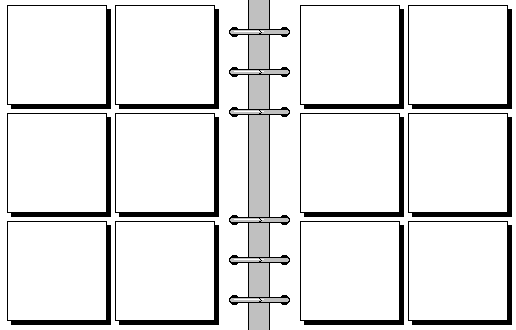
the image as an attachment. It will be best if you allow each of the 12
boxes to be 100x100 pixels. That way I will not have to resize your
creation. Resizing often involves some loss of information, implying work on
my part to restore it. If you feel 100x100 is too restrictive, don’t worry
too much about it; but if you do choose to work within a resolution of
100x100, consider dowloading one of my GIFs (for example, the one shown
below) and modify it with your favorite image-editing program.
- Some people prefer to hand-write the images, as this
gives them a different kind of freedom on what to draw (and makes
qualitatively interesting images). In that case, please scan your hand-made
image, or take a picture of it, so that you can send me a digital image in a
reasonably common format (JPEG, GIF, BMP, PNG, TIFF, PCX, etc.).
- The hardest one for me (and least desirable): Send me the
solution in verbal form, trusting that I will find it interesting enough to
draw the problem myself. I would prefer to work on the image of your problem
though, actually trying to solve it, and thus get an idea of how difficult
it is. If you just mail me the solution, the fun part will be spoiled.
What information to include in your email:
- The attachment/URL/solution, as explained above.
- Your full name, so I can include it with the problem’s
data.
- Your home page URL, if you have one, which is another
piece of information on my index page (your
e-mail address, of course, is not part of my index page).
- If you provide the image of the problem, hide the
solution in the email somehow (e.g., by prepending a sufficient number of
blank lines).
Once again, thank you for your creative donation to the BP
databank.
Back to Harry’s “main” research page