This page is part of the author’s set of pages on religion. 0. IntroductionReligion is a fascinating subject. Now, I am not religious, I am an atheist. To most people, religion is a personal matter, and if there is any fascination in it, it’s in the fulfillment they feel during the moments they experience communication with supernatural beings. But how can religion appear fascinating to a non-believer? Why, of course religion is fascinating even if you are not a believer, because it poses so many interesting questions that — from an atheist’s point of view — require an explanation: Why Is Religion Here? Why are people religious? Why so many people are religious — why is it the rule to be religious, and the exception to be an atheist? Religious people would guffaw with my
naïveness. But wait, I don’t think it is so simple. For one thing, the three great monotheistic religions that talk about a God who created humankind (Judaism, Christianity, and Islam) emerged only in the last 4,000 years (the Jewish tribes are estimated to be at most that old, see here). But do you know for how long we humans have existed on this planet as the same species, Homo sapiens? For approximately 150,000 years!(*) How can it be that nobody was talking about God (the God) for tens, and even hundreds of thousands of years? Yes, people have always been religious, but what kind of religion did they have for almost their entire existence? For nearly 150,000 years there was no talk of God. Our hunter-gatherer ancestors believed in ghosts and ancestor spirits. If religion is here because of God, how could God allow this? What the heck was God doing during all this time that we have been around, folks? Please take a look at the following line, which shows (in blue color on the left) the approximate length of time that we have been on this planet without any notion of God as conceptualized by the monotheistic trio, compared to the length of time that the concept “God” started appearing in people’s minds (red color, on the right):
In reality, even the above drawing is flattering for monotheistic religions. The concept “God” did not appear suddenly, full-fledged in people’s minds as we know it today. The ancient Jewish God was very different from the one of the modern times: he was an anthropomorphic God. He had a thunderous voice, legs to walk with on the garden of Eden, and other bodily parts that we don’t need to mention here, lest some people might feel offended. In addition, he was not Omniscient! Clearly he wasn’t, because, as we shall see at the end of §3.1.1, Moses could argue with him and make God change his opinion! — ridiculous by today’s understanding of “God”. It is thus obvious that the concept “God” evolved in the minds of believers, until we reached the God-spirit of the Christian religion in the last 2,000 years: a God who is occasionally depicted and imagined as a respectful and healthy Old Man; and the Allah of the Islamic religion in the last 1,300 years, who has no gender(*) and cannot be depicted at all. Also, humanity as a whole did not switch to the notion “one God” suddenly, 4,000 years ago; the Jews were but a minute percent of the entire human population (they still are), and it took the Christian religion and its adoption in Europe, and a bit later the Islamic religion and its adoption in the Arabic world, for the concept “one God” to take off. Even today, people in the most populous nation, China, do not believe in a monotheistic God, creator of the universe. So, if religion is here because of God, then God has created a peculiarly fragmentary and localized (both in space and in time) image of himself in people’s minds. It’s a “God with a thousand faces” that appears in the world. Why? But my purpose is not to argue with the average believer. For them, all questions are answered, all cases appear closed. Believers usually enjoy staying in a tranquil state of mind, in which questions of fundamental importance, such as whether God exists, or whether there is an afterlife, are not asked at all. They refuse to question the very foundations of their belief system, and this is very understandable, because such questioning would put in danger the entire edifice, which they don’t want to shake and destroy. My purpose is to write down an explanatory system for the phenomenon of religion primarily for myself, because as a cognitive scientist I am very interested in understanding how the mind works, and one important property of human minds is their religious beliefs. But why did I write this web page, if I am interested in an explanation for my own satisfaction only? Because it is not productive to be talking to oneself; I need to receive feedback, primarily from those few believers who do not feel threatened by putting under the microscope of reason even their most basic religious assumptions. So, certainly, under the assumption that God exists, there is hardly any question to be asked about the origin of religion (save for the objections I presented earlier — see the figure with the colored line, above — but the believer can always cop out with a “God’s ways are mysterious” retort). The question of the origin of religion becomes important only under the assumption that God is a creation of the human mind. If you are a believer and feel offended by this assumption, there is always the Back button on your browser. If you are not offended, you might either be a non-believer, or a believer who simply is curious to see how an atheist would answer the question of the origin of religion (for example, you might want to prepare yourself and gather ammunition for the next occasion a non-believer brings up this issue in a discussion). In any case, assuming that I am not offending the reader, I proceed now to the main topics of this text.
1. Explanations for the Origin of Religion1.1 Why Are People Religious?A religious person would have the exact opposite question: why are some people (like the author) non-religious?(*) But is the issue symmetric? Is a religious person as much justified in asking this question, as the author is in asking why so many people are religious? I will argue in this section (§1) that the issue is not symmetric:
However, the above analogy is not very accurate because one can always opt to lose the excessive weight by going on diet; but in the case of religion, there is no recipe to follow to lose it, for two reasons: first, religious people do not think there is something wrong with their religious beliefs, or that their beliefs are causing harm to other people. And second, there is a strong genetic factor in religion (stronger than any genetic predisposition to acquiring weight), which is an idea that will be discussed later (§3.2). Religion is mainly a cognitive phenomenon, and thus traditional evolutionary approaches fail to shed light to all of its aspects. This is not to say that biology has no useful information to give us for a deeper understanding of religion. For example, as Frans de Waal[1] and Marc Hauser[2] tell us in their recent publications, the core of the sense of morality that almost all humans share has a biological foundation: other primates may not have to decide on issues such as abortion and euthanasia, but they do have to deal with stealing and murder on a regular basis. (This subject will be developed further in the section on the origins of morality, see §2.1.) Indeed, a comparison of our cognitive abilities with those of other animals will help us understand the basis of the answer to the question “Whence Religion”. This is what I discuss next.
“This elder chimp just died;
in fact, all chimps die, sooner or later; No, you wouldn’t. To put it simply, you wouldn’t have the mental capacity to make the above complicated thought. Some pieces of the thought would be reachable (“This elder chimp just died”, “I am one of them” — though they wouldn’t be expressible in such linguistic terms, of course), but others would be completely beyond your mental horizon (“all chimps die”, “so one day I will die, too”). Your basic mental handicap as a chimp (or as any other non-human animal for that matter), is that you cannot conceive of the notion of “remote future”. Only humans can do that.(*) Not all future would be inaccessible to you — for example, you would be able to hide a piece of food from your peers, knowing that you would be able to retrieve it soon, maybe even in a few days. But you wouldn’t be able to think of a future that extends beyond a few days ahead. You wouldn’t understand what “in a few years” means. Thus you couldn’t possibly ever fear your own death. The fear of death can be lessened and thus become bearable with the belief in an afterlife, which assures the believer that death is not the end of it all. As we shall see in §1.1.1 (immediately below, criticizing Pascal Boyer’s book “Religion Explained”), practically all religions and metaphysical belief systems either promise an afterlife, or directly imply its existence. Thus, religion plays the role of a strong painkiller against the psychological stress caused by the fear of death.
1.2 Darwinian ExplanationsEvery specialist tends to see the world through the spectacles of their own area of interest. The theologian will find religious implications in any given aspect of nature, the artist will marvel at and be inspired by it, and attempt to represent it in an artistic medium, and the biologist will try to outline a Darwinian (evolutionary) explanation for it. Religion, as an aspect of (human) nature, is no exception: biologists have proposed evolutionary explanations for the emergence of religion in humankind. These will be briefly discussed below. Religion, from a biological point of view, appears on the surface just as puzzling as the tail of a male bird of paradise: so cumbersome that it becomes dangerous for the survival of its holder. A male bird of paradise rises with difficulty from the ground, given the weight of its long tail feathers, thus becoming easier to capture by predators. This disadvantage is more than compensated, however, by the appeal that such fancy tail has to the female bird. Similarly, possessing religion can be dangerous for the individual: religious human sacrifice was practiced regularly until our recent past (well into the historical times) as a means to pacify some nonexistent entity, a god, or gods, i.e., ideas in the minds of religious people. The mythologies and legends of various cultures describe such stories of human sacrifice. In The Iliad, Iphigenia, the virgin daughter of the king-leader of the Greeks, Agamemnon, is sacrificed on the altar in order to appease the gods so that they send propitious winds that can set the Greek fleet in motion, to sail against Troy. In the story, goddess Artemis is supposed to intervene at the last moment, replacing Iphigenia with a deer. This story is repeated in two versions in the Jewish Bible: one in which the sacrificial victim, boy Isaac, is replaced at the last moment by a ram through an act of God before being slain by his father Abraham, and another one in which a virgin girl is actually sacrificed by her father, who believed that God helped him to become victor in a battle (thus he offered his daughter as a thank-you present to God; more details to follow later on). Even though these are just mythological descriptions, it is reasonable to assume that they echo actual ancient customs and practices. Evidence of real human sacrifice has been found among native American cultures of Central America (Aztecs, Mayas) and South America (Incas), always as part of religious rituals. Even non-human sacrifice, i.e., the concept of wasting resources (food) to appease gods, works against survival. The counter-argument is that the notion of sacrifice was developed only after our ancestors passed from the hunter-gatherer mode of subsistence to farming, which provided surplus resources, making possible (or even necessary) the idea that some of them could be wasted. But religion can be detrimental to health not only due to sacrifice. At the time of this writing, there are frequent reports of suicide bombers in the Muslim world: people who arm themselves with explosives and detonate them in order not only to exterminate their enemies, but also to reach their creator and thus live blissfully and eternally after their suicide — at least that’s what they believe. In earlier, pre-farming times, a person concerning him/herself with religion would be wasting precious resources and energy in activities that fail to fill an empty stomach. But every seemingly burdensome feature, be it the tail of the male bird of paradise or religious activities of human beings, must have some non-obvious advantages that compensate for the losses. What are the biological advantages of religion? Since we are looking for evolutionary explanations, we must consider religion not as it mostly appears now, but as it used to be during most of our existence as a species. (This issue will be further developed here.) The following evolutionary explanations have been proposed:
Other biologists see religion not as benefiting the individual, but as a byproduct of some other important biological or psychological property. The British biologist Richard Dawkins, for example, proposes (without insisting that this must be the definitive explanation) that religious feelings are feelings that start during childhood as obedience to the authority of the parents, and later, in adulthood, misfire and become feelings of obedience to an image of a fatherly and loving God.[13] Undoubtedly, children have evolved to trust their parents’ advice without questions. (Those children who did not, had fewer chances to survive and have descendants.) Once the idea “Trust authority without questions” is established in a young mind, it becomes deeply ingrained, and it later misfires by trusting the authority of the tribal elders, priests, and the “ultimate parent”, God. Although this idea is interesting, one wonders, couldn’t humans evolve so as to lose the ability to blindly trust authority as adults, just as children lose their ability to learn natively languages later in life? But still, Dawkins proposes this as a possibility only: as an example of how religious feelings could be the byproduct of some other function of the human intellect. Personally, I find evolutionary arguments weak if their purpose is to explain religion in its entirety. The reason is that, although religion might have started as a primarily biological phenomenon with evolutionary advantages, it turned into (should I say “evolved”? — but in the wider sense) a primarily cognitive phenomenon. Thus, biological evolution is insufficient as an explanatory device for religion, unless we restrict ourselves to the times of hunter–gatherers, shamans, beliefs in ancestor spirits, etc., and forget about paradise and hell, churches, mosques, rabbis, priests, imams, popes, ayatollahs, prayers, masses, holy inquisitions, crusades, missionaries, fundamentalists, holy books, and all the rest of paraphernalia that are the products of the development of human cognition, to which we turn our focus in the next section. 1.3 Religion as a Viral MemeIt has been more than two decades since the idea that some of our thoughts might be copied from mind to mind in an evolutionary-like process first appeared in Dawkins’s seminal work, The Selfish Gene.[4] Dawkins coined the term “meme” for any such self-replicating idea (by analogy with the word “gene”), and the term has stayed with us ever since (1976), as a new meme (the “meme meme”). Dawkins also suggested, at the very end of his book, that religion might be seen as a “viral” meme. This idea was developed somewhat further in Susan Blackmore’s The Meme Machine.[5] To understand how a viral meme can commandeer a person’s mind, allowing the person to believe that the person is in control, it is useful to consider an analogy offered by the philosopher Daniel C. Dennett at the very beginning of his recent book, Breaking the Spell.[6] Dennett writes of an ant that exhibits a peculiar behavior:
Dennett then goes on to compare the situation of a mind of a religious person “taken” by religious memes, to the situation of the brain of an ant that is similarly “taken” by the parasitic genes. Dennett’s analogy should not be construed too literally, of course. For example, the parasite Dicrocelium dendriticum has a metabolism, so if it does not find a host such as a sheep or cow to complete its life cycle, it will presumably die. Not so with the religious memes (thoughts, concepts), which lack metabolism, and can stay in the believer’s mind indefinitely. But, just like the ant with the D. dendriticum, a believer will engage in certain rituals (for example, going to church every Sunday), over, and over, and over. Again, the reader might object that the ant does the grass-blade climbing ritual unthinkingly, whereas the believer goes to church by his/her own free will (and would avoid going if something urgent happened). Certainly, a human mind with a set of religious memes is an immensely complex system. Dennett’s analogy is not meant to belittle a religious mind, reducing it to a mindless automaton, such as that of an ant’s. It does not mean that a believer has the brain of an ant! (for Pete’s sake, as someone complained to me; after all, if a believer is an ant, we are all ants — including Dennett and this author!) The analogy only points to the fact that a religious mind is a normal mind plus some set of ideas (the religious memes), which cause the believer to exhibit some behavioral patterns. One of those patterns is that the believer will try (and usually succeed) to convince his/her own children of the “truth” of those religious memes, so that the memes will be transmitted to the child; and so on, generation after generation. The believer believes that the transmission is done by the believer’s own free will. Fine. But an alternative viewpoint is that this is only a cognitive illusion. After all, how many believers ever thought, “No: I will not teach my own children anything about my religion; instead, I will let them find out about God by themselves.” Believers almost never entertain such thoughts, so where is the “free will”? But even if an occasional believer does entertain this thought, religious memes are not passed only by parents to children, but also by the social environment in which children grow up. To say “I will not teach my children anything about my religion” is like living in a house where every adult has the flu, and hoping futilely that you won’t pass your viruses to your children if you simply do not sneeze or cough in their face. But there are other memes in people’s minds. Why should only the religious ones be called “viral”? Why should only they be denigrated with a label such as “virus-like”, and not do the same for other memes, e.g., those that a non-believer has regarding God’s non-existence? Why, isn’t an atheist “taken” by the atheism memes? Because there is an important difference between memes and memes. The religious ones “want”(*) to spread. To this end, religions traditionally organize missions, sending their missionaries to places deemed “ground suitable for sowing the word of God”. (Which means, minds so weakly infected by other, feeble religious memes, that the new and superior ones will spread like the plague — and Churches are usually dead right.) Believers typically make monetary contributions to such missions, considering it as one of their religious duties. In contrast, non-religious memes do not seem to have any “wish” to spread, and so they don’t even qualify to be labeled as memes (a meme is an idea, or set of ideas, that appears as if it wants to spread; other examples are given below). Though religious missions are known since it was financially feasible to organize them, I have yet to hear of the first atheistic mission.(*) Atheists, agnostics, and other non-believers, do not gather regularly at a place listening to the sermon of an atheist priest. There are no atheist temples, no rituals, no prayers, no priests, no bishops, no missionaries, no holy scriptures, no donations for the advancement of atheism in the world.(*) These concepts are all attributes of religion, and that is why there is an asymmetry between believing and not believing, and why religious ideas qualify as memes, whereas their absence does not.(*)
Now, if a non-believer’s ideas do not even qualify as memes, but religious ones do, why are the latter labeled as “viral”? What are examples of non-viral memes? Non-viral, or normal memes, are sets of ideas that generally spread from person to person, but without causing the mind that possesses them to engage in repetitious rituals, nor wanting to pass them on to successive generations. For example, a tune that plays in your mind and causes you to hum it, sometimes for an entire day, could be called a meme. It is transmitted by radio waves, electronically, optically (burned on CD’s), or simply by listening to another person humming it. A new trend in fashion would qualify as another meme, or complex of memes. Certainly, such memes will cause you to exhibit some behaviors (you might go to the music store to buy a CD, or to the department store to buy a fashionable pair of shoes), but they will not cause you to perform rituals, nor congregate with other people to reinforce the rote learning of those rituals, nor summon your child one day and tell him/her in a very solemn voice, “Listen, sweetie: I want to talk to you about a very important tune/fashion that there is in this universe, which I would like you to remember/follow for the rest of your life.” Are there any other viral memes, besides the religious ones? I think so. Every ideology, every “-ism” that involves a hierarchical organization with leaders and subordinates, some text that spells the ideological principles, gatherings in which rituals or near-rituals are performed, fundraising campaigns, and propaganda for spreading the ideology of “-ism”, including perhaps some magazine or newspaper controlled by the top echelons of the organization, qualifies as “viral” in my view. Followers of such ideologies generally wish to see their children involved in the same organization (i.e., be infected by the viral memes of the ideology). The difference with religions is that the child’s environment (e.g., school) is usually not contaminated by the same ideology, so the viral infection is not as effective as in the case of a religious doctrine. (Usually, but not always: communism would be an example of an ideology with a complex of viral memes that infested even the schools of societies that employed it as the sole form of governance.)
Young students receiving Islamic
education in Afghanistan. (These come from pictures taken in the
summer of 2007, The above analogy of religious memes with viral genes can be interesting for the non-believer, because it provides a new perspective on religion, but might appear hostile, even abominable to the believer. Objectively, the analogy misses a crucial point: whereas biological viruses are often detrimental for the health of infected individuals, religious memes must have played a crucial and beneficial role in the evolution of our species. Without them, we might not be around. This idea is further developed in the sections that follow. 2. The Evolution of ReligionWhen we think of “religion” today, we usually have the present state of religion in the world, in our minds. There are more than six billion people, and well-known religions (e.g., those followed by over 100 million people) account for around 80% of the entire population of Earth. (Source.) The indigenous tribes of Africa, the Americas, Asia, and Australia, account for only 6% of the total today. But has the situation always been like this? Could it be that we now witness a very recent and rather atypical view of religion? If we want to understand religion deeply, where it came from, and what it meant to human beings throughout our existence, instead of just how it appears now, we need to acquire a clear picture of how people and their various religions changed over the eons; in other words, how religion evolved in time. Specifically, we need to know the answers for the following questions:
Note that, although — superficially — only the last two questions appear to concern religion, it is wrong to try to answer only them ignoring the rest, which are prerequisites for properly understanding the answer for the last two quesions. So let’s proceed, answering the above questions one by one. The first three questions are the easiest ones to answer, because data in the form of fossil findings and DNA analyses have been accumulating for some time, converging on roughly the same conclusions.(*)
Isn’t this modern conclusion wonderful? Well, to some people at least (like me) it is, while to others it’s not exactly music to their ears. Groups of people that would feel disturbed by this conclusion, besides religious fundamentalists who insist to take the word of their holy book literally, include all racists, and others who insist on the purity of their origins; because, besides everything else, this conclusion implies that our earliest ancestors were all “black”. We are all “blacks”! All people on Earth: “white” Americans, Australians, and Europeans (including Adolph Hitler, let us not forget), Jews, Arabs, Indians, East Asians, American Indians, Australian aboriginals, Eskimos, and of course people of African descent anywhere on the planet, we all have only “black” ancestors, if we move sufficiently far back in our genealogy. The fictional characters Adam and Eve, if they existed they would have to have chocolate-colored skin, too. Nobody’s roots are “purely white”.
At this point some readers might experience a conceptual difficulty in accepting the above estimate. If our ancestors started at any number as large as the above, how could they be the first ones? How did they arrive to the world, didn’t they have parents? If not, then who created them? If yes, then wouldn’t their parents (and grandparents, and grand-grand...) also be our ancestors? The long answer is already given on this page of mine, so I will not attempt to repeat it here. The short answer is that we are not talking about some specific instant in time, some beautiful day on which we take a snapshot of the human population, count heads, find them to be 15,824 (say), and decide that these and none else count as our “original ancestors”. Of course it doesn’t work like that. We are talking about a period of time that lasted for thousands of years, maybe even tens of thousands of years, during which our ancestors were changing from what we now call Homo erectus to Homo sapiens. During this period of thousands of years, people were at a transitional stage between the two species, and they wouldn’t be placed squarely into one kind or the other. All of those were our ancestors: the Homo erectus individuals before the transition, the transitional ones, and the Homo sapiens individuals after the transition was complete. Note that this is a general process that applies to all living kinds that evolve and change from some ancestor species to some descendant one; it’s not particular to our kind. And, please, before considering writing to me, complaining that what I describe is logically impossible, make sure you have read and understood my long answer (see the page referenced above). But how could a mere 10,000 to 20,000 individuals be spread out in a vast region like the one depicted on the map, above? The answer is that the region on the map shows the approximate area where our ancestors could have been roaming for thousands of years; it’s not an area that was populated by some specific 10,000–20,000 people at some particular instant in time.
For several tens of thousands of years, perhaps until around 100,000 years ago, our ancestors remained in the region of Africa shown earlier. Throughout this time, the only tools they were making were simple stones, chopped on one end to make them pointy (by hitting them with other stones), by which they would kill game, carve flesh out of bones, and occasionally crush the head of a member of a rival tribe. (There is no evidence for this latter idea, but I doubt anyone would seriously contest it.) Their mode of subsistence must have been the “hunter–gatherer” one, by which is meant that men “hunt” (which, more often than not, includes collecting nuts, roots, fruits, etc., rather than killing game, as Jared Diamond[11] points out) and women collect the food at home base, store it, prepare it for consumption, and distribute it. Many tribes of Africans and American Indians continue to operate in this mode of living today, and that’s where our knowledge comes from: direct observation. (It is assumed that the mode of living of contemporary indigenous tribes has not changed in some essential way until our times.) During a period between 100,000 and 60,000 years ago, a great shift in intelligence appeared among our ancestors, a shift that has been termed “the Great Leap Forward”[11] by paleoanthropologists. The old clumsy stone-made tools were replaced by other, more delicate ones, made mostly of bone. Interestingly, forms of art (making beads and other ornaments, painting) appeared at the “same time” (bear in mind that the time referred to here spans thousands of years). Anthropologists and cognitive scientists suspect that the improvement of competence in language made possible this “sudden” burst in creative activity. This does not mean that brains grew larger. Our present brain size had already been reached by our earliest ancestors, around 200,000 to 150,000 years ago. Greater intelligence might be the result of qualitative (better organized neuronal connections) rather than quantitative change. Whatever the causes, the Great Leap Forward coincided with a physical “leap forward”, by which our ancestors left their original location of Eastern Africa and spread, gradually, to the rest of the world.
The above map, adapted from Lewin[7] and Olson,[9] shows the general routes our ancestors took while moving out of their original region in Eastern Africa. Note that one route involves the crossing of the Strait of Bab el Mandeb, the narrowest point where the southwestern tip of the Arabian peninsula nearly touches Africa, sometime between 80,000 and 70,000 years ago. (The K stands for 1000 years on the map.) Although the Strait is so narrow that can hardly be seen on the map (see also the previous enlarged view of Africa), its 27 kilometers (17 miles) presented a formidable task of navigation to earlier species of humans.(*) Perhaps by this time our ancestors possessed enough curiosity to attempt a risky trip over the sea, enough general intelligence to conceive of something like a raft, and enough complexity in verbal communication to coordinate the building of a raft by several peers. Whatever the cognitive skills involved, we know that H. sapiens arrived in Australia around 65,000 years ago. However, this should not be imagined as a single brave expedition that was accomplished during a single lifetime. Instead, it involved the gradual spreading of tribes along encampments that remained at a reasonable distance from the seashore, over thousands of years. The spreading happens because people are pressured by crowded conditions to explore new and untapped resources. Soon after the time people reached Australia, some of Australia’s large marsupial mammals were driven to extinction. This, besides human bones, is an additional indicator of the time around which people reached Australia. Another route involves moving northbound on land, passing over today’s Egyptian peninsula of Sinai, and from there to regions of Asia and Europe. However, their spreading should have been far from effortless and unhindered, because somewhere in today’s Israel, and then further in Turkey and southeastern Europe, they must have met with the previous inhabitants of those regions, the Neanderthals. The latter must have been an offshoot of our ancestor species, Homo erectus, which had already inhabited the Old World (Africa, Asia, and Europe) since around 1.5 million years ago, starting once again from Africa. Thus, there have been at least two out-of-Africa events: an earlier one, of our ancestor species H. erectus, and a more recent one, of our own H. sapiens (the event described here; note that Alan Templeton describes a third such event, between the two mentioned above, plus a more recent event of moving from Asia back to Africa — see Dawkins,[30] pp. 57–60). The Neanderthals appeared as early as 500,000 years ago, and were completely extinct as late as 24,000 years ago. Molecular evidence reveals that some of our non-African ancestors mixed slightly with the Neanderthals. That is, humans of Eurasian origin have a Neanderthal genetic contribution that ranges anywhere between 1% and 4% (source). Note that the arrows on the map, above, do not mean to depict specific routes taken, but rather indicate the general direction of spreading of our species. The Americas must have been inhabited no earlier than 13,000 years ago, by people who crossed the Bering Strait (the 92 km or 58 miles of sea that separates Siberia from Alaska), at a time when the sea level had dropped due to glaciation, exposing the land where the water is shallow and turning the Bering Strait into a land bridge. The first native Americans were blocked by glaciers and stayed in Alaska for some time (a few generations), but eventually the glaciers receded and people managed to migrate southwards into today’s Canada and the U.S.A. From there on, it took them only 1000 years to reach Patagonia, at the southern tip of South America.[7]
But for around the last 10,000 years (only), our mode of existence changed drastically. Specifically, it acquired the following attributes:
These attributes were not independent of each other. It is because of the farmer mode of subsistence that large populations — much larger than before — could be fed and maintained. Also, large populations brought about the emergence of classes among people (merchants, soldiers, slaves, scribes, aristocrats, and, last but not least, priests). It was because of farming and agriculture(*) that human populations could now afford to feed classes of people who did not work in order to earn their living (e.g., soldiers, priests, aristocrats), something that was unthinkable in the previous, hunter-gatherer mode of subsistence. One of the consequences of the division of human populations into classes was the structural “complexification” of religion: instead of a single shaman-king of the tribe, there was now an entire class of people, the priesthood, hierarchically organized with a supreme leader (e.g., a Pope, an Ecumenical Patriarch, a Grand Ayatollah, etc.), a few individuals close to the supreme leader (archbishops, ayatollahs), and more individuals farther from the leader, and closer to the base of the pyramid (bishops, priests, muftis, imams, etc.). An excellent source that explains not only the above, but also why agriculture arose in particular places in the world and not in others (resulting in the perceived “supremacy” of the “white” people, when in fact any technological advancements by “whites” were granted to them by mere strokes of geographical, botanical, and zoological luck), is Jared Diamond’s Guns, Germs, and Steel,[12] a Pulitzer Prize winner, and a must-read for anyone who wonders why some “races” appear more capable, and hence dominant, than others. It should be noted that in very recent times — perhaps for the last 300–400 years, after the Renaissance — a considerable part of humanity has switched to a third mode of subsistence: the mode of services, in which the product of one’s work is not something edible, or even tangible, but it can still be of value to other people. For instance, it can be insurance, a movie, a novel, a piece of software, a lottery, a piece of legal advice, a deal, or simply a re-selling of somebody else’s work. Because many of us earn a living in this mode of subsistence, it is easy to overlook the vast effect that the farmer mode have had on human society. Yet, just as the services mode is very short compared to the farmer mode, so the farmer mode is very short compared to the hunter-gatherer mode. Another observation is that the emergence of each mode does not imply the elimination of the previous ones: there are still hunter-gatherers in many places of the world, but they tend to play a peripheral role in global world affairs. With the above in mind, let’s examine a graph that depicts the growth of human population over time.
The population is shown on the vertical axis, whereas time is on the horizontal axis, and it corresponds almost exactly with the Western notion of “year”; that is, time zero corresponds to 1 AD (or 1 CE), or to 1 BC (or BCE), whichever you prefer; time -2,000 corresponds to the year 2000 BC (or BCE), give or take one year, an adjustment that has no significance at all for the purposes of the above graph. The blue region on the bottom-right shows approximately how the human population changed over time. The data to construct this graph were taken from this page, and this one. A version of this graph can be found here. We see that the the growth of the curve on the above graph is such that the population remains nearly invisible for more than half of the time depicted, until it becomes visible and starts rising in historical times, shooting sharply upwards in recent times. But the most interesting part for our purposes is not the visible, but the invisible part of the curve; specifically, the length of the invisible part. Notice that the graph stops on the left at -10,000 (at which time the data suggest a population of 4 to 5 million). That’s not the beginning of our species, though; it is an arbitrary time, shortly before the emergence of agriculture. If we were to include the whole duration of existence of our species, with the conventional time -150,000 on the left (where I estimated earlier the size of our population to be around 10,000 – 20,000 individuals), we would need to extend the graph 15 times to the left, with the population curve coinciding exactly with the horizontal axis throughout this leftward extension. If you have a hard time imagining this, then picture it on the next figure:
The above figure by itself tells us nothing more interesting than that our population curve took a sharp increase shortly after the emergence of agriculture. What’s more interesting is that throughout the hunter-gatherer mode of subsistence, and even later until well into the historical times (i.e., for the entire part where the height of the curve is practically zero), the religious beliefs of people had nothing to do with God; they were beliefs based on ancestor souls, ghosts, good and bad spirits that inhabit the woods, the lake, the sea, or other unknown, dangerous, and scary places, and so on — just the sort of beliefs that the few remaining hunter-gatherers hold today (they will be discussed a bit more, soon). If we want to plot the rise of the monotheistic religions that sprang from Judaism in the above graph (i.e., Christianity and Islam), then we get the following:
Monotheistic religions in which the notion “God” is dominant are marked in red, above. The appearance of Judaism is marked as starting shortly before time zero, keeping the curve practically at zero for a while due to the insignificant number of Jews compared to the world population, and from time zero and beyond it is largely due to Christianity, and then in addition to Islam, that the red portion of the graph shoots upwards. Before rushing to accuse me of “painting God into a corner” (rather literally), consider that the above graphs were constructed out of hard facts; they hopefully give us a clearer perspective of the magnitude and duration of the idea “God” (the God meme) in humanity than we tend to attribute to it today — at least for those of us who live in cultures imbued with the notion of “God”.
It is hard to answer the first question with any degree of certainty, but there are indications that beliefs that today we would categorize as “concerning the supernatural” emerged around 100,000 to 90,000 years ago. How do we infer this? Because that’s the approximate time that we encounter the most ancient graves with anything like objects that accompany the deceased person (e.g., source). Burials might have happened even earlier (though not much earlier), but a plain burial is not evidence for belief in an afterlife. For example, the relatives of the deceased person might loathe to see their previously living relative being consumed by scavengers.(*) But if there are objects in the grave, together with the dead body, what purpose could these objects serve other than to accompany the person in his or her afterlife? Of course, it is always possible to object to this idea, countering that the living relatives might not want to be seeing the deceased person’s belongings anymore, because such objects would cause them psychological pain. It is always possible to speculate with counter-arguments against something that is a mere interpretation of a fact (the fact is that objects were found in graves), but one should keep the various interpretations under a rational perspective. For instance, if you want to get rid of objects, you can dump them somewhere else, not necessarily in the grave (as if the latter is a trash bin). Αlso, we don’t find just any random collection of belongings, but ones of particular types, of rather symbolic value. The fact that we can’t find this practice before 100,000 years ago, means that most probably it is because people did not have the cognitive capacity to entertain the idea of afterlife prior to that time. But the precise time at which belief in the afterlife emerged is not very important. What is more important is to understand what kinds of religious beliefs our ancestors used to have during most of our existence as a species. Given that their mode of subsistence was that of the hunter-gatherer until fairly recently (i.e., until around 10,000 years ago), we can draw conclusions about their religious beliefs by observing the few remaining modern hunter-gatherers. Anthropologists have been doing precisely that for a long time, and a lot of data has been accumulated. The overall picture that emerges is that hunter-gatherer religious (or better described as supernatural) beliefs revolve around souls of deceased ancestors, witches, fairies, other spirits, etc.. When something bad and unexpected happens, such as the roof of a hut collapsing, the explanation offered can be that some imaginary but well-known bad witch caused this intentionally, to hurt some people (in Boyer[3], ch.1). The members of the tribe might gather and discuss, trying to figure out why the witch wanted to cause harm, and how to appease her. Bad weather might be caused by the displeased souls of ancestors, and thunders might be their angry voices. If one walks alone, away from the tribe, spirits good and bad accompany this person, who is then at their mercy. This is a mere medley of typical hunter-gatherer supernatural beliefs. Since they do not possess any more specific beliefs about gods or God, we might call these beliefs religious, instead of superstitious. However, today not only most people do not live in a hunter-gatherer world, but also most people do not have religious beliefs of the hunter-gatherer kind, such as those described in the previous paragraph. Today the overwhelming majority of people are believers of a handful of religions, the dominant ones among which are descendants of Judaism. This change in “style” of religious beliefs is not a coincidence. The hunter-gatherer “style” of beliefs was unsuitable for the later, agricultural world, who developed beliefs in specific gods, who were often also creators of the world, or of parts of the world. Let’s see briefly some of those more recent religious beliefs, as they were shaped by the time of the farmers:
Now, if God had physical legs to walk with on a physical garden, and presumably a mouth as well, one wonders, what other organs did that God have? He couldn’t be an assembly of just two legs and a mouth, could he? There should be a head with a brain (that did the thinking before the talking), a body to hold the head and legs together, and who knows what else. But this is not the only narrative in the O.T. that describes an anthropomorphic God. In Exd 33:9-23, for example, God talks to Moses “face to face” (Exd 33:11) shortly before giving him the ten commandments. Moses pleads to God to allow him to see his face, God refuses (because anyone who sees his face must die, Exd 33:20), but allows Moses to see his back parts (Exd 33:23). Well, if the Jewish God had a head and legs to walk with, it is little wonder that he also possessed a back side (along with its appurtenances, presumably), but what is important is that the excerpts from Exodus show a consistent view of God in the O.T. This anthropomorphic view, which is in full agreement with the anthropomorphism of gods of other civilizations, contemporary with the Jews, continues in the first centuries of Christianity. For example, Jesus himself is thinking of God as having a human form, as revealed by these verses of the New Testament:
Of course, today’s theologians and pious believers would passionately argue that the above is to be understood figuratively. However, the idea of a “figurative interpretation” can only be argued for today, many centuries after Christianity’s collective understanding of God had already evolved into a pure spirit, devoid of human-like features such as legs, mouth, head, sex, etc. (though not of thought — read this page of mine to see the problems that arise with a God who thinks). Nobody today can claim to know exactly how the author of Matthew 5:34–35, his contemporary Christians, and even Jesus himself (assuming Matthew is accurately reporting Jesus’ words) were thinking of God. Islam shows a similar “evolution” in how God (Allah) was imagined then and now. Although now Muslim theologians claim that Allah is a “pure spirit”, Muhammad himself was imagining Allah as having human features. This is revealed by the following “strong” (authoritative) narration (“hadith”):
As we see, Muhammad, eager to show off his wisdom to his clueless companion Abu Dhar, revealed how he was thinking of Allah: as someone who sits on a Throne, underneath which an equally anthropomorphic Sun prostrates, asking permission from Allah to rise again, with Allah giving permission each time, and so on. (So, given the 4.5 billion years of existence of the Earth, and that the Earth was spinning faster in the beginning and had a day lasting much less than 24 hours, we conclude that the Sun has asked permission from Allah more than a trillion times, [1,000,000,000,000] and Allah hasn’t got bored yet of answering “Yes!” each time — wow!) This stupefyingly childish view of an Allah who sits on a Throne is admitted even by Allah himself in the Qur’an:
The “Throne”, where Allah is sitting, is supposed to be
mounted on top of the 7th heaven. (In the Islamic view of the universe there are
seven heavens stacked on top of each other, like roofs, and on top of them all
is the Throne of Allah. Don’t chuckle!
However, as the centuries passed, both the Christian and the Islamic view of their God evolved; so now Christians and Muslims think of their God as a pure spirit, with no human attributes (although it is not so uncommon for Christians to draw God as an Old Fatherly Man when they need to depict him; most Muslim denominations refrain from depicting either Allah or Muhammad, with the exception of the Alevi Muslims). The Old Testament God’s physicality and human-like figure, as opposed to the later Christian/Islamic spiritual God, is only one indicator of the evolution that religion went through. Another indicator is the evolution of God’s morality. This is the subject of the following section. 2.1 Biological Foundations of Morality and its EvolutionThe O.T. God is a God whose acts would be objectively judged as morally despicable by any person of today who is not blinded by the viral memes of Judaism and Christianity. To corroborate the previous statement with some evidence, recall that God obliterates two cities by burning all their inhabitants — apparently including the babies — because they were immoral,(*) but saving one couple: Lot and his wife, who however made the error to turn and look back over her shoulder, and God instantly turned her into a pillar of salt (Gen 19:24-25). Earlier, the same man, Lot, had proposed to some thugs who were pestering him (trying to break the door of his house), to give them his two virgin daughters, to do as they pleased with them (Gen 19:8), provided the thugs would leave Lot and his male guests in peace! In an earlier episode, God exterminates the entire population of Earth in a Great Flood (except Noah and his family; again, favoritism does not seem to be an accusation that would make God — or rather, the authors of the Bible — blush). Even earlier, God asks an old man, Abraham, to sacrifice his only son, and the moment Abraham is ready to deliver the deadly blow with a knife to the child on the altar, God replaces the child with a ram.(*) But at a later instance, a virgin girl is roasted on the altar by her father, Jephthah, a general of the Jews, who vowed to God that he would sacrifice anything/anyone who would come out of his door first and come to greet him upon returning home, should God help him achieve a great military victory (Jdg 11:30-40); this time God did not deem it necessary to replace the poor victim with some ovine, so the girl was turned to the first documented human barbeque. This is only a brief anthology of the gory violence and — by today’s standards — moral corruption that is presented as virtuous and commendable (or merely worth-mentioning) throughout the Old Testament. A much more complete one can be found in Dawkins’s The God Delusion,[13] pp. 237-250. What happened to God later? Why did God change so drastically, and from a genocidal, misogynist, diabolically jealous bigot(*) — in comparison to whom, Satan appears like a true angel — turned into the fatherly benign spirit of the A.D. times? We must believe either the incredible, namely, that God himself improved, or a much more economical explanation: that people’s ideas about their own selves (how they should behave toward others, etc.), improved, and this improvement was reflected in how people imagined their God. We have a different set of moral principles now, according to which it is immoral for a higher authority to inflict damage on the weak and helpless.(*) This was not so only a few decades ago, and the situation appears worse and worse as we move back in time ([13], pp. 262-272). How did we acquire our modern concepts about morality? Where did our morality come from? Is it heaven-sent? Could it ever have come from religions that brandish holy books which extol the making of shish kebab out of the flesh of virgin girls? Highly unlikely. Could there be a more natural origin of our morality? This is examined in what follows. Once, a few years ago, I received an email message from a psychologist writing from Fort Belvoir, Virginia. She had just read an earlier version of this page of mine, where I discuss what I consider to be the two main contradictions in religious ideas about God, and wanted to give me a lesson in matters of faith, belief, the universe, where we come from, how I “do not understand God’s attributes as revealed by scripture”, and so on. The next day I received a message from her husband, “a physicist for 23 years and now a seminarian”, who, after presenting his religious point of view, cautioned me about his wife. He said, “I will argue for [God’s existence], she will attempt to prove.” Indeed, the next day his wife, filled to the brim with religious certitude and her culture’s arrogance,(*) set out to prove to me that God exists, by drawing what she thought was an ace from her sleeve; specifically, posing what she thought is a real conundrum for any atheist: where did our morality come from? After exchanging a few more messages, I soon realized there was exactly zero possibility to establish any line of communication with that person. She seemed to me as mind-deaf as a rock (a rock of faith, perhaps?), and after a few days I dropped out of the discussion, figuring that if we continued, we would be talking like signal-exchanging ships cruising along opposite directions at night. What remained in my mind as an interesting idea after this exchange was the psychologist’s conviction that the question “Where did our morality come from?” is answered like this: “It came from God! We are moral because God is moral, and He wants us to be moral, too!” Amazing. Why would people who are expected to be rational thinkers, like the psychologist and her ex-physicist husband, consider this circular reasoning(*) to be an answer at all? How can rational people fail to see the sorely missing explanation in this “explanation” of human morality when they attribute it to the morality of a higher being? Why don’t they ask themselves, why is that morality the way it is and not otherwise? Conceivably, we could be living in an evil God’s universe, couldn’t we? It could be a malicious God who has an army of scourge-inflicting angels to serve him, and who has banished the only benevolent angel, the Satan, to hell: the only place where good things happen 24/7. That God would want us to be bad like him, and so, crime would be rampant in our world, and the few good-doers would be incarcerated, serving long sentences in jail. Well? Why is reality not like that? Religious people usually balk at the idea of questioning the origin of their God’s attributes. Typically, their answer is “God’s ways are mysterious”, not realizing that this is another way of saying “I don’t know, but I don’t want to admit that I don’t know.” The issue of the shutting down of the faculty of logic by religion will be examined later on, but now we can try to answer this question: Would it ever be possible for us to live in a malicious God’s world, as described above? Anyone who believes that the origin of our morality is God and can think rationally would have to admit that the fact that “good” is laudable and “evil” is punishable in our world is a matter of mere chance. There is a 50% chance that our God could be evil,(*) and wanted us to be evil, too. It so happened that our God is good — that’s what the believer must believe. But my view is different. No, our world could not be one in which evil prevails and good is the exception. It is not a coincidence at all that we live in a world in which teachers and spiritual leaders urge us to be good, and in which the minority of people who commit crimes are isolated from the majority. Our morality is explicable by recourse to biological principles, according to which there is no 50-50% chance to be moral or immoral; our world could not be different from the way it is. This is what is shown immediately below. Let’s start with a thought experiment, which I will then implement as a program and turn into an actual experiment, so we’ll verify that the thought experiment really works that way.
My guess, when I thought of this situation, was that the T-animals would gradually disappear. How slowly, or how fast? Depends on how many of them practice theft, and how effective the thieves are at stealing: the more stealing that occurs, the faster the T-species should disappear. The thieves themselves, individually, might thrive and spawn more descendants than those who do not steal. (Recall that since these are animals, there are no prisons to incarcerate or punish in other ways the thieves; so there is no reason why the thieves should not thrive.) But the species of T-animals as a whole would disappear as time goes by. Why? Because, regardless of the habits and fates of individuals, if we take a bird’s-eye view and look at the two species as two wholes, we’ll see that the W-species is a more efficient consumer of food, i.e., a more efficient transducer of food into energy (motion), than the T-species. The former converts all the food it encounters into energy and descendants, whereas the latter occasionally “eats its own flesh”: that’s what an act of stealing is. If food items are found both in the environment and in the possession of T-animals, then each time a T-animal steals food items from others, no food accrues to the T-species as a whole; instead, some food items are exchanged among its members. This might benefit some members, but it would be detrimental for the species as a whole. As an analogy, suppose your body corresponds to the T-species, and the cells of your body are the individual T-animals. Some of your lung cells are responsible for taking oxygen from the air and direct it into your bloodstream. If all cells do this job as expected, fine. But if some of them, instead of taking oxygen from the outside, attack neighboring cells and strip them of their oxygen molecules, your respiration will suffer. If all of your lung cells are into this stealing business, you’ll soon die of asphyxiation. Is this thought correct? Theory and thought experiments like the above are the province of philosophers. I am not a philosopher, I like to build systems, usually by programming them. When I have a question and a theory such as the above, I immediately think of writing a computer application that simulates the system exactly as I imagined it, so that I let the program run and see what happens. If I were a mathematician, I would like to put down the “axioms” of my system (“there are two kinds of animals”, “each animal lives for time x”, and so on), and then try to prove that either the proposition “species T as a whole disappears”, or the proposition “species T thrives indefinitely”, follows as a theorem. But, not only am I not a mathematician, but I suspect that real mathematicians would have trouble proving such propositions. What I described above is called a “chaotic system” in computational theory, and often the only way to deal with such systems is to let them run and observe what happens.(*) So, let’s do it: let’s build such a system and see what the outcome is. Here is the program:
What you see above is the space (black rectangle) where our animals live their lives. The space is littered with food items (“plants”, green circles). It contains also some W-animals (yellow), and an equal number of T-animals (red). As it stands initially, the space has 1500 food items, 50 W’s, and 50 T’s. Now click on the button that shows a green triangle. You’ll see that the yellow and red (W and T) animals are set in motion. While they move randomly, they encounter food items, grab them, and grow fatter. After collecting enough food (if they do), they might spawn more of their kind (one child per birth event). After some time, they die. A “time unit” is called an “epoch” in such simulations, and each animal makes one random step in space per epoch. You can see the number of elapsed epochs on the bottom-right corner, on the status bar. The same status bar shows the numbers of W-animals (“workers”, on the left), and T-animals (“thieves”, center). Watching how these numbers change is the whole point of running this simulation. Pressing 2-3 more times on the button that starts the program (while the program is running) you increase the speed of the simulation. After you familiarize yourself with what is going on, increase the speed a bit, and then even further, until what happens on the main area (the “space”) is too fast to keep track of, so then concentrate on how the numbers of W’s and T’s change. With the given parameters, the T-species will vanish at any time between epochs 50,000 and 70,000 (these are not hard limits, but an approximate range), whereas species W will stabilize its size somewhere around 100 individuals. No matter how many times I repeated this simulation, I always observed the same result: species T invariably dwindles and finally vanishes. You can repeat the simulation by pressing the 4th key (with the two purple triangles), which initializes the program at its initial random state, and then clicking on the button that sets it again into motion. I would like to list now precisely the parameters of this simulation, because they correspond to the axioms (initial assumptions) of an axiomatic theory. The exact values will also help the reader judge the reasonableness of the system.
The reader will notice that there are plenty of parameters used in the above description (i.e., all those numbers mentioned explicitly). Several of these parameters are essential for the viability of the populations. Thus, if the probability of 0.95 for an animal (worker or thief) to turn into a food item after dying is lowered somewhat, then there are not enough food items returned to the environment during animal deaths, and the populations die gradually (regardless of their type), due to starvation; whereas if this probability is increased somewhat, then too many food items are generated over time, and the populations of the surviving animals increase without limit. But note that such changes affect all animals, no matter what their type is, so they are not important. The important observation is the following:
Let’s take another look at the disclaimer “all other factors being equal”. In real life, theft of various degrees (including extreme ones, such as cannibalism) is practiced among many animal species, including humans. This is true because in real life not all other factors are equal. For example, obviously, if there is no competition for resources with another species, there is no reason why theft should be bad for the species, provided theft is not the only way of acquiring resources. Or, if competition exists, but one species has an advantage over another for completely independent reasons (e.g., it develops resistance to heat, which the other species doesn’t), then again the disadvantage of theft (disadvantage for the species, that is), can be counterbalanced. For these reasons, theft, or what we would call “crime” in general, is observed in the biological world. But what this simulation shows is that theft, or crime, is bad for the species as a whole, especially if it becomes the sole means of acquiring resources. And if something is bad for the species as a whole, then it is bad in the long run for the individuals comprising the species, or rather, for the descendants of those individuals (for their genes, as we’d say in modern parlance). For, if a species goes extinct, what difference does it make if its individuals enjoy short-term benefits from crime? In the long run the species will vanish, so whatever evolutionary advantages accrued to the individuals (or to their genes), they will be thrown to the dustbin of paleontology. This idea, no matter how obvious or how well supported by both evidence and proofs by simulation, is hard for most biologists to digest. The reason is that what they see missing is evolution. They see that certain principles of evolution are not satisfied at the species level. In particular, species do not normally spawn children with random mutations, only individuals do. (If a species evolves to a descendant species, the latter does not differ from its parent by random mutations, but is adjusted to the new environmental conditions.) So what happens at the level of the species is a peculiar kind of “evolution”: it is rather “change dictated by environmental adaptations”, not the familiar Darwinian evolution. Some biologists(*) (many, I suspect), might have difficulty accepting an idea that does not follow from the most fundamental principle of biology, i.e., Darwinian evolution, so they balk at the suggestion that principles can exist at the level of species that can take precedence over the evolutionary principles that work at the lower levels of individuals and genes. However, that a principle cannot be conveniently put under the umbrella of another, cherished principle, should not be a reason for rejecting it. The principle of competition at the level of species is established both mathematically (by simulations such as the above, because simulations that do not depend on external input are pure formal systems, akin to mathematical proofs), and biologically,(*) by observation of the fossil evidence. Of course, one might reject the idea that this simulation shows anything significant, by appealing to the multitude of uncontrollable factors that exist in reality, which are ignored in the simulation. Granted, a simulation is by its nature an idealization, so a large number of factors are ignored (otherwise it wouldn’t be a simulation, but the real thing). But when we want to examine a situation scientifically, the tradition suggests using the analytic method, by which we strip the problem of its irrelevant details, and home in on the essential ones. For example, if we want to examine the free fall of objects in physics, we remove noisy and irrelevant factors such as air resistance, wind speed and direction, and whether there might be an earthquake at the place where the falling object lands. By eliminating all these irrelevances we can make a simulation of free fall on our computer, and observe the falling “object” (e.g., a dot on our screen) move down at a constant acceleration. This is all I tried to do with the above simulation: home in on the essentials. I also would like to mention that it is necessary to have two abilities to correctly assess the importance of the above: first, to be able to isolate the relevant from the irrelevant factors; and second, to make a cool and rational judgment regarding one’s motivation for posing an objection: is the motivation really the suspicion of a flaw, or is it the subconscious urge of wanting to find a flaw, because the correctness of the argument threatens one’s own cherished beliefs? It is not wrong to want to find a flaw, provided one is not blinded by such wishes and throws rationality out the window. However, given that the reader indeed keeps the above in mind, I would be very interested in learning about possible flaws of the above simulation.
“But, hold on a second,” the above-mentioned psychologist might retort. “This is precisely the point: human morality is not just about stealing and killing. It is so complex! Where did all this complexity come from, since you admit it’s not present among the animals?” My answer is that each species follows a set of moral rules the size of which correlates with the cognitive and social complexity of the species. For example, trees have no cognitive abilities, hence morality is not a concept that applies to them. Squirrels have a rudimentary cognition, and very little social interaction among themselves, so their moral principles are confined to the very basic core described in the above simulation: “Don’t try to find your food solely by stealing from thy neighbor squirrel, don’t cause harm to thy neighbor”, and perhaps a few more that I am not aware of because I am not a biologist studying squirrels. My “prediction” (it’s a prediction only because I do not know) is that beavers, although they possess a brain of approximately the same size as that of squirrels, must be following slightly more complex moral principles because they form large communities, so they experience many more social interactions than squirrels. Wolves, also with complex social life, have a larger brain and more complex cognition than beavers, so they must be capable of following even more moral principles. (Again, I don’t know, I am only “predicting” out of ignorance.) Perhaps the animals with the most complex set of moral rules aside from humans are gorillas and chimpanzees, who have large brains and experience intricate social lives, forming families, clans, tribes, etc. We, humans, are simply at the top of this pyramid, having unquestionably the most complex cognition, and being a quintessentially social species. Just as our minds are several orders of magnitude more complex than any other animal’s, so is our set of moral rules. We put under our umbrella of morality issues such as abortion, euthanasia, and — courtesy of the Catholic Church — the use of condoms for avoiding the spread of the AIDS epidemic.(*) Of course, to have the capacity to even consider such issues, an animal must have a mind of at least the human complexity, and we are the only such animal currently on Earth. To recapitulate:
But is proposition 1 correct? Are animals moral, even rudimentarily so? Even this has been disputed, mostly by philosophers. It has been argued that the human nature is really the animal nature, which is assumed to be lacking morality, whereas what we perceive as human morality is only a façade, the fleece of a sheep by which we have hidden the wolf inside. Frans de Waal calls this the “veneer” theory of human morality,[1] and provides ample evidence against it. For example:
In short, whereas some philosophers or others who don’t have direct experience with animals imagine that animals are inherently immoral (mere brutes as the literal and figurative meaning of the word suggests), scientists who work with animals and collect evidence observe that there is a core of animal morality, which correlates positively with the cognitive and social complexity of the animal species. But human morality cannot have only a biological foundation and nothing else. There must also be a cognitive dimension in it, because our species has not changed substantially from a biological point of view (it has been the same species, after all, with a given brain capacity for at least 150,000 years), whereas our morality standards keep being enriched up to the present. As a case in point, slavery was considered normal only a couple of centuries ago, and racist thinking was normal even among intellectuals, less than 100 years ago. (More on this, below.) The difference with today is that although racism and even slavery exist, they have been branded as scourges, and no rationally thinking intellectual would accept them today as normal. Our moral standards keep evolving. 2.1.1 The Bible as Guide for Morality
The fact that our moral standards keep evolving should normally act as a signal to religious people that our morality cannot be based on religion, because the holy books of all major religions were written more than a thousand years ago. And yet, this is apparently what religious people think. Christians, for example — like the psychologist and her seminarian husband — believe that their morality is caused by God, and expounded in the Bible. It is very hard to persuade them that they cannot be more mistaken, because they refuse to read their Bible. They have either only a hearsay knowledge of it, or a fragmentary knowledge which is the result of cherry-picking: they read only what they like reading. If they could read all of it, however, they would realize that the so-called “good book” is one of the most horrible recipes for moral standards, because besides their familiar “cherries” it includes the following “onions”:
How about that for a good cherry-picking? Or
does it sound more like onion-picking to the believer? Well,
perhaps it does, but they should understand that there are plenty
of foul-smelling onions (I didn’t even list them all) in the
book they brandish and claim that it elucidates and expounds
their morality. If the morality that they follow in their daily
lives originated from this cesspool of moral advice, today they’d
be serving long sentences behind bars.
Most Christians believe that God is the source of their morality. At the same time, some Christians (the majority, I suspect) believe that God is the true author of the Bible (that is, God inspired its authors, who wrote it with divine guidance). But if this is true, then we must draw one of the following two incredible conclusions:
Since none of the above two alternatives seems plausible, the mystery remains if we attribute the source of our morality to God. But the mystery vanishes if we avoid this error, attribute the source of our morality to our biological origins, and observe the mere fact that human morality evolved in time, and keeps evolving. We can then conclude simply that the authors of the Bible imprinted in it the morality of their times. 2.1.2 Islamic Sacred Texts as Guides for MoralityDid the morality of the world improve later, several centuries after the Bible was written? Well, the “morality of the world” is not a notion with a single value; we can’t measure it, say, in the 3rd C. BCE and find it to have a value of 0.2, and then measure it a thousand years later and find it to have advanced to 0.5! Different parts of the world exhibited different moral standards throughout time. So, moving forward to the 7th C. CE we still find examples of barbaric, atrocious, even inhuman morality in the world of monotheistic religions. Specifically, we learn about the morality of ancient Islam by reading the texts that are considered sacred in the Islamic world. These include the Qur’an (or Koran), the Hadiths (narratives) of Sahih Bukhari and Sahih Muslim, and the Sirat Rasul Allah (life of Allah’s Messenger) by Muhammad ibn Ishaq, and al-Tabari. These texts give us a glimpse of what was considered normal, or socially accepted, in the times of the ancient Muslims (all except the Qur’an, because the Qur’an is supposed to be about what Allah himself [or itself(*)] dictated to Muhammad, so it’s not a narration of historic events). And what we learn in these texts appears shocking to the modern reader. In particular, we learn that, in Muhammad’s society, it was normal to kill your adversary who criticized you! There are at least three examples in which Muhammad himself had his opponents killed (i.e., instigated or directly ordered his Muslim followers to murder his critics) because they said or wrote things against him: (Warning: the bulleted section that follows quotes the Islamic texts, which describe some atrocities in graphic detail; if the reader feels that such reading might be disturbing, I strongly urge the reader to skip the bulleted section.)
The above is only a sample of a larger whole, not just a few and isolated incidents in which Muhammad had his critics silenced by murder. More atrocities and inhuman behavior are described in the Islamic holy texts, such as the brutal torturing and eventual killing — under Muhammad’s orders — of some thieves of camels (Bukhari:V4B52N261), the torturing and beheading of other opponents of Muhammad’s (Tabari 8:122; ibn Ishaq:515), and more. I have written more extensively about these in this page, so I prefer to avoid repetitions here. But even today, Islamist leaders follow in the steps of the founder of their religion: in 1989, the supreme religious leader of Iran, Ayatollah Ruhollah Khomeini, issued a fatwa ordering the murder of Salman Rushdie, an Indian expatriate living in England, because Rushdie had written a novel (“the Satanic Verses”) that, according to Muslims, was an insult to Islam and Muhammad. More recently, a situation having a lot of the flavor of Rushdie’s case erupted in late 2005, and became known as the “Muhammad cartoon controversy”, when cartoonists depicted Muhammad in a Danish newspaper, an act considered blasphemous in Islam. More than 100 people died in protests that occurred in the Muslim world, and some Muslim leaders issued death threats against the newspaper publishers and the cartoonists themselves. That incident has been adequately caricatured in this page. An overall theme emerges after considering all the above:
Interestingly, there is a Quranic verse that nearly advocates the above rule explicitly: “Fight in the way of Allah with those who fight with you, but do not exceed the limits, surely Allah does not love those who exceed the limits.” (Qur’an 2:190) But the very next verse contradicts the previous one, continuing like this: “And kill them wherever you find them, and drive them out from where they drove you out, [because] persecution is worse than slaughter. But if they cease, then Allah is forgiving, merciful.” (Qur’an 2:191–2:192).(*) Could the morality of Muslims have originated from Allah? Note a phrase quoted above, uttered by Muhammad to his decapitated critic: “Allah has slain you”. Either Muhammad was right, or he was wrong. If Muhammad was right, then Allah slays people, decapitating them! If Muhammad was wrong and this murder was not committed by Allah, then it was committed by Muhammad himself — perhaps not by his own hand, but by the hand of one of his men, which morally makes no difference at all. In either case, either Allah or Muhammad committed a murder. (If only it was the only one!) Given all the evidence that exists in their own sacred Islamic texts, rationally thinking, I conclude that Muslims who truly believe in their religion today can belong to one of the following three categories:
I believe that, for the vast majority of today’s Muslims, the first of the above three options is the case, given the rampant illiteracy in the Islamic world (source). Most Muslims either don’t read about their religion and have a hearsay knowledge of it, or are given to read only specific excerpts from the Qur’an that are not morally offensive. (There are plenty of morally offensive passages in the Qur’an — a few can be found in my earlier-referenced page — but Muslims engage in the same kind of cherry-picking with their Qur’an as Christians do with their Bible.)
2.1.2 Morality Keeps EvolvingNot only has our present-day morality come a long way from the wretchedness of the Bible and the Islamic texts, so as to consider notions such as infanticide, slavery, murder of one’s critics, and treating women as belongings of men abominable, but we keep evolving our moral standards century after century, decade after decade. The concept “All men are equal” appeared only after the Enlightenment, in the 18th century.(*)
Another famous writer of science fiction, the British H. G. Wells (1866 – 1946) wrote the following in a utopian work of his,[22] in 1902:
Yes, this was written in 1902. Doesn’t it sound more like the ramblings of Adolph Hitler, or one of his close associates, Goebbels, maybe? Yet it was penned down by H. G. Wells, an intellectual (and a supposed progressive!) of the time. If Wells could write like this, endorsing the most despicable and reprehensible form of Social Darwinism,(*) one cannot avoid thinking, is it any wonder that the Holocaust followed only four decades later in Nazi Germany? Today we read such passages with horror (and shame for the thoughts entertained by fellow humans), but back then — only a century ago, mind you — the word and concept “genocide” did not exist, nor had the world been “burned” yet with the wounds of World War II. And yet, our moral awareness continued growing. Women’s right to vote (suffrage) was established in the U.S.A. only in 1920 (with the 19th Amendment), and this was among the first places in the world where women could vote (though not the first; women had already gained suffrage by the end of the 19th C. in places like Britain, Australia, and New Zealand). African Americans did not gain suffrage in all States until well into the 1960’s (by the Voting Rights Act of 1965). The notion “one person, one vote” is indeed very recent (and is usually thoughtlessly quoted as “one man, one vote”). What about today? Are there any moral precepts for which we should feel shame, causing our descendants to write derogatorily about us, despising our standards? Sure there are. For example, we often treat animals in ways that cause them to suffer greatly. I envisage a “golden rule” of the future for animal treatment that will be approximately as follows:
Thus, a fly has no way of perceiving anything about itself, because its cognition does not afford it such an achievement — it is merely an intricate reacting device. The only reason for which I do not harm flies — or other creatures for that matter — is because I see them as marvels of what the evolution on our planet can achieve. But the cognition of a chimpanzee is sufficiently complex to allow the animal to represent in its mind its own self, its immediate future, its possible suffering at present, etc. — not in as complex a way as a human being, but close enough. Experiments harming great apes have now largely subsided, but we are not yet at the stage of litigating for the rights of animals, and punishing the violators of law. Many scientists continue administering their lethal experiments on monkeys and other smart mammals, mainly in the U.S.A. Other nations, such as Japan and Norway (both among the nations with the highest per capita income), continue killing whales, unashamedly. The Chinese contribute to the killing of rhinos, because they have the largely bogus belief that an extract from the horn of a rhino has beneficial medicinal effects. Many Asian cultures still value and use ivory, thus encouraging poaching that eliminates elephants in Africa. The term “animal genocide” is still unknown, even unthinkable: we are not there yet. All the same, one day these nations will be condemned by history, as our descendants will write it. 2.2 Evolution of Rituals[This sub-section is not ready yet.]
3. Properties of the Religious Mind3.1 Is Rationality Appropriate for Understanding Religion?A few days after the Christmas of 2007, a correspondent from South Africa wrote to me a letter in which he expressed an idea that has been repeated often by believers (and has not been well-received by non-believers): that religion cannot be understood rationally and scientifically because it requires faith, and faith is the opposite of rational thinking. When you believe something, you believe, you don’t seek to explain why you believe. Here is a short excerpt of the argument, in my correspondent’s own words:
Note that although my correspondent argued with Christianity in mind, the exact same argument could be advanced by Muslims. They, too, would argue that God (Allah) cannot be approached by reason. After all, the notion of submission to God without questioning is central in Islam. Because Christianity and Islam account for a very large percent of today’s believers, I will not specialize the argument to Christianity but will generalize it to “religion”, with the understanding that it might not apply to some other, non-mainstream religions. Other believers have proposed an analogy that might appear particularly illuminating. Think of a piece of art, they say: a painting, for example. Would you be able to appreciate the art in the painting by reason alone? Would you expect to use logical rules, such as: “If the red hue on the upper-right corner on the canvas is between 128 and 184, then...”? Or: “If the logarithm of luminosity exceeds the square root of saturation at pixel [1054, 3582], then...”? No, come on, art cannot be appreciated by means of any set of such rules. It must be felt. Likewise, religion is felt by the believer’s “heart”,(*) it does not require nor expect any justification from the microscope of the reasoning mind. This just cannot be digested well by some non-believers’ stomachs, who want rationality to be always at work. But non-believers have their own argumentation, too. The philosopher Ronald de Sousa has described philosophical theology as “intellectual tennis without a net”, an idea that is best explained by D. C. Dennett in the following excerpt (Dennett is speaking to an imaginary believer who claims that reasoning has no place in religion):[24]
Instead of reasoning about faith, my correspondent argued that this must not be done, and that, indeed, this is the error that believers often do: they engage in argumentation with non-believers, and so the believers implicitly agree to play with the rules of the non-believers, since reason is needed to conduct even the simplest intellectual discussion — lest one would be free to make the most ridiculous statements, as Dennett demonstrated. Believers shouldn’t argue (read: reason), they should just believe, my correspondent claimed. And yet, such correspondents evidently keep reading this text at least up to the point that caused them to compose an email message and send it to me. They have the curiosity to go through a large part of this article and see what is said in it. And they use their reasoning ability to do so, because without reason not even a Mickey Mouse story can be understood. So believers have two options, it seems: either follow my correspondent’s advice and stop reading now because this is a text that reasons about religion (though it’s already too late, since this is an advanced point in the text), or keep reading, but with the understanding that they do something they probably shouldn’t be doing. Will you keep reading, dear reader, in case you
are a believer? Do you have the intellectual curiosity to see how
I will argue that reason (through science, in particular) can
approach and perhaps explain religious feelings, at least in
principle? I bet you do. Otherwise you wouldn’t be reading
this. At this point I’d like to mention briefly an argument put forth by atheists quite often, because it will be treated more properly in §5.1. First, believers say: “Is there any difference between a believer’s faith in God, and a non-believer’s faith in rationality? In the end, they both require faith! Isn’t it obvious that the moment you opt for rationality as your mental tool you’ve made an arbitrary choice, which cannot be justified on the basis of rationality itself, because that would amount to circular reasoning?” To this, some atheists retort as follows: “Your computer works because rationality and the sciences that rest on using reason predict that it will. Look around you and try to realize how many of the objects that you see — including such low-tech things as the walls of the multistory building in which you possibly reside — would be impossible without the scientific reasoning method. So, faith in rationality and faith in faith are not exactly on par with each other! The former produces results and makes correct predictions about the world, whereas the latter produces nothing tangible, and has made no prediction of a repeating event that has been repeatedly verified (to bar chance prediction of single-instance events).” This answer of atheists refers to the practicality of religion: it is only relevant if we request practical and — obviously — positive results from religion in people’s lives. In that case, the question becomes: “Which is better as a benefactor in people’s lives, science, or religion?” (Perhaps they are both benefactors, and one must decide the use of one over the other only in those issues where the two disagree, giving conflicting answers; this will be examined in §4.3.) But the believer is not required to focus on the practical aspects of religion. For many believers, religion is important because of its spiritual help and guidance, not because of its ability to explain the natural world, or to predict its future. Insisting that religion produce practical results is akin to requiring the same of art. We don’t have to request this from religion, just as, for instance, we don’t require from a painting by Rembrandt to make verifiable predictions and create tangible products (other than attempts to copy or steal it). No, my correspondent’s argument was not about the practicality of religion; it was a theoretical, a logical one. My corresponding believer made a solid, rational argument, which is this: the moment we find a rational explanation for why rationality is preferable over faith in approaching religion, we have fallen into the vortex of circular reasoning: we used rationality to justify itself. But the believers are not exactly pure and innocent in this debate: they use reasoning — plain mathematical logic, actually — to force non-believers to admit that they cannot justify rationality, i.e., that rationality must be taken as an axiom; and then, the moment they achieve this, they drop the tool they made an excellent use of, and cry triumphantly, “Now let me use only my faith, okay?” That’s exactly what Dennett was complaining about: believers use the net of reason only as a fence against the opponent’s serve — for as long as it suits the believer — but drop the net when it’s their turn to serve. To summarize this theoretical debate, non-believers are guilty of trying to lift themselves off the ground by pulling up their own bootstraps, and believers are guilty of shameful duplicity, changing the rules in mid-game to suit their purposes. Must we conclude then that believers and non-believers speak different languages, and never the twain shall meet? What alternative is there other than considering reason and faith (read: science and religion) as two different domains that must not interfere with each other? Must we accept Stephen Jay Gould’s proposal that science and religion constitute two “Non-Overlapping Magisteria” (NOMA’s)?[25] In Gould’s view, each “magisterium” occupies a separate realm of human cognition. Science informs us how the natural world works, and religion informs us how we ought to behave morally. Each magisterium is separate, and they should not interfere with each other. Gould’s idea of NOMA’s has been rejected by Dawkins,[13] who argued that the notion that there exists a super-human, supernatural intelligence who deliberately designed and created the universe and everything in it, including us, is a scientific hypothesis, and is therefore not exempt from scientific examination. But my correspondent’s idea (which I suspect is shared by many other believers) is not about God-as-Creator of the physical world (which, admittedly, is a physical problem), but about God-as-Redeemer (for Christians), and as Recipient of Personal Communication that takes place between the believer and God (for believers of most major religious denominations). It’s a personal, subjective issue, one that doesn’t admit rationality to creep in — so believers would say. But here is a way in which although rationality cannot prove faith wrong, i.e., it cannot completely dethrone and kick away faith (for we concluded that, logically thinking, this leads to circular reasoning), it is possible that rationality can paint religious faith into a corner. Indeed, if that happens, the “corner” will be so narrow that to keep on relying on faith in the face of the alternative, rational explanation of religion would border on the comical, in the same sense that believing today that the Earth is flat is comical.(*) The earlier phrase “if that happens” means that we are not there yet; we don’t have the necessary knowledge to conclude the analogous of a “round Earth” conclusion in the rationality vs. faith controversy; but we’re getting there. The following analogy might help understand the idea.
That our knowledge about star creation would grow and change the status of the Genesis 1 story from matter-of-fact to oh-it’s-an-allegory was not evident at all one century ago, because back then knowledge was missing. Could it be that, likewise, we now live in times during which it is not evident at all that future science, through observation and reasoning, will illuminate and explain religious faith, turning it to nothing more than a special mode of mental operation? I think so, but note that here I am expressing only my personal bias. I might be wrong, and it is only the overall evidence (including future one) that will tell us if I am right or not. The evidence that makes me having this hunch exists and keeps coming, although at a rate that implies that my lifetime might not suffice to witness the complete scientific explanation of the religious mind. Still, some evidence is already here. Specifically, here is how rationality encroaches little by little in the realm of faith, and how scientific research gnaws, bit by bit, at the throne of the magisterium of religion:
Now, I wrote above that the meditators did this switching off of the orientation area of their brain, and thus reported the mystical experience — the Tibetan monks felt one with the universe, the nun united with God. But one might retort that this doesn’t prove that there is nothing external to the brain that causes the switch-off. It might be that a supernatural power switches off that part of the brain, allowing you to have the mystical experience. However, this is not a very convincing thought. For one thing, it would reduce God to a mindless automaton. You concentrate in your meditating way whenever you want, and, if you are skillful enough, God is there (supposedly causing your orientation area to switch off). You stop, and God ceases tinkering with your brain. You concentrate again, you get God with his “spiritual screwdrivers”. You cease, God whisks away. Aw, come on! This can’t be God! Such an automaton that obeys fully your volition — come! – leave! – come back! – go away! — seems less intelligent than an elevator. Still, I appreciate the thought that, just as the visual cortex evolved to allow us perceive (see) real external objects, maybe regions in the parietal and temporal lobes evolved (or were designed like that by God) to allow us perceive real external entities of the “spiritual” realm. Sure, it’s a possibility. And just as I agree that it is a possibility, religious people might want to reciprocate by admitting that it is a possibility that the religious sense is a purely internal mental state, independent of the external world (spiritual or otherwise), akin to the sense of hunger, the organ of which (the digestive system) perceives not an external world but our internal need for food. As I wrote in the beginning of this section, we don’t know yet. To form an informed opinion, one must first acquire as much knowledge as possible on this and all related subjects.
All the above experiences fall squarely into what people describe as “spiritual”. Without detailed knowledge of how the brain works, the feeling during such experiences is that an external “spiritual world” is directly perceived, and causes the experiences. But by studying the brain we learn that more economical explanations exist, which avoid the innumerable unanswered questions raised by the admission of the existence of a “spiritual world”, and according to which various regions of the brain turn off or on, and cause us to misattribute the source of our experiences from an internally generated to an external source. In ancient times (and even in our times to some extent, depending on culture) people used to believe that dreams come externally to us, sent by some deity. But today most sensible people understand that dreams are internal creations of our subconscious. Religious experiences are usually more intense than dreams, and happen under special conditions, so they’re less readily accessible and have been studied to a lesser degree. But when their cognitive functioning is thoroughly understood, there is little doubt that the “magic” (read: “spirituality”) will be explained away. This does not mean that people will cease enjoying spiritual moments; only that they will not be misattributing their source to external agents. So this is the sense in which the rationality of science can help us understand spirituality. It is not possible ever to be absolutely sure that there is no external spiritual world because, for all our thorough understanding of human cognition in the future, it might be that the spiritual world wants to make us believe that when we examine the brain thoroughly we explain spirituality away; so the spiritual world tricks us to believe that it doesn’t exist. Certainly, it could be. Likewise, you can’t ever be absolutely certain that there is no Ghostly Leprechaun acting to contract the biceps brachii muscle every time you flex your forearm. It might be that although you think you understand perfectly how the biceps brachii and the other muscles of your arm work — especially if you are a doctor — there is still a Ghostly Leprechaun who causes your muscular cells to contract, and tricks you to believe that it doesn’t exist because of your full understanding of muscular functions. Of course. But it is more economical to believe that there is no Ghostly Leprechaun since it’s redundant, and, from a certain point of view, it is saner. When did I realize I was God?
Well, I was praying 3.1.1 Does the Religious Mind Avoid, and Can even Be Hostile to Reason?The short answer is: Yes. Absolutely. Religion is hostile to reason. But religious people will often deny this, subconsciously realizing that it’s a “bad idea” to avoid supporting one’s thoughts with rationality and logical reasoning. Now, I need some evidence to back up this claim. As an appetizer, let’s start with the following:
On the left we see a picture of a painting of a Greek Orthodox monk, posted on the wall of one of the many monasteries of Meteora, a site of breathtaking natural beauty in central Greece, not too far from the famous Mt. Olympus. The monasteries of Meteora are built on top of enormous rocks that sprout out of the green land, thus appearing as if they are natural extensions of the rocks (see picture on the right). But let’s magnify the sign at the bottom-left of this picture, which is the English translation of the Greek sign that hangs just under the painting of the monk. Here is the translation (with my emphasis, below the picture), which I took from a different angle:
They don’t like reason, those monks.
How beautifully they put it, how concisely they state their
principles! “Rationalism [i.e., relying on reason] is a form of disbelief, a
lack of faith.” In other words, either you believe using faith, without asking
questions, or you use your thinking processes, which require reason, common
sense, logic — an enemy of faith. It’s either the one, or the other, say the monks. “Rationalism
[...] lead[s] to an absolute belief in the supremacy of the self”, they claim.
Of course! Relying on your own self, your “own powers of reason”, is so bad for
us monks, who should be the only ones who have control of your thoughts.
You must submit yourself to us (err... to God, we mean), allow
us, the mediators between you and God, to guide your life and tell you what
to do and how to think. For, if you start questioning authority with your
reason, God knows what troubles you might bring to our way of living, which
relies on you to voluntarily support us with the essentials. ( But the above is only one of those very rare explicit confessions of guilt — openly admitting being guilty of shunning reason and logic. More interesting are the cases in which the religious person is incapable of using logic, without realizing their inability, unwilling to admit this fundamental incompetence that most of them have. Once again, some evidence is needed to back up this claim. The video to be given next shows a theology professor in a lecture, answering questions from the audience. Someone from the audience, whom the professor calls “Sophie” (perhaps students from his regular class were among the audience) asks the following question:
The question, perhaps, requires an explanation. Believers (Christians and Muslims alike, although the question is posed in a Christian context) believe that God is Omniscient; which means, God knows everything, including the past, present, and future. Yes, please note that: God knows the future. He knows what is going to happen, and with absolute certainty. Nothing can happen that would surprise God. Once again, I need to emphasize this, so much that I’ll place it in a frame:
Now, let’s see the video. But first, a warning: it’s boring! Terribly boring! So make sure you first read my comments in the paragraph under the video.
In the video, the professor of theology goes on, and on, and on, for 20 minutes, continually beating around the bush, but never homing in the essence of the question: since God knew with 100% certainty (being Omniscient) that Adam and Eve will in fact eat from the fruit of the Tree, why did he tell them “Don’t eat from this Tree”? It looks like God preplanned Adam & Eve’s doom, but made it appear as if they were responsible, when in reality God was fully responsible, with 100% responsibility. For, if you are 100% certain of the outcome of something that you plan, then you are 100% responsible for it — by common sense and plain logic: assume your responsibilities, one-hundred-percent, don’t load them on the shoulders of others! The poor professor deviates to such red herrings as the Egyptian Queen Nefertiti’s tomb (10:10) and “fabulously wealthy” Phoenicians (14:28), spending some time looking for people known to him in the audience, admitting in the process that such luminaries of theology as Calvin, Luther, and St. Augustine failed to answer this question, only to propose in the end his own answer: God let Satan loose, so that people can learn what kind of doom will befall on them if they follow Satan’s advice; forgetting, the poor fellow, that the doom was preplanned with a 100% certainty by God himself, the Omniscient fella. Why would people be responsible for a disaster that you planned for them, and which is guaranteed to happen, since, being Omniscient, nothing can happen that would surprise you? Why should Adam and Eve feel guilty afterwards, since they really had no choice but to eat the forbidden fruit? And they had no choice because they couldn’t do otherwise, given that God knew the future with 100% certainty, a future that had Adam & Eve with the forbidden fruit in their stomachs. If the fruit was not to be found in their stomachs in the future, then God wouldn’t know the future! It can’t be that He both knows the future and does not know whether the fruit will be present in their stomachs. (“You can’t have the pie whole and eat it” — quite literally in this case.) So, He should be held accountable for their doom, since he preplanned and executed it. In the YouTube site, under the video, in the comments section, there are literally hundreds of comments that repeat the same faulty logic: “God gave free will to humans, so that by exercising their free will they are responsible for their actions. It was Adam & Eve’s free choice to eat from the Tree, therefore they sinned and should be punished.” Which means, there are hundreds of pieces of evidence that religious people lose their ability to reason logically when it comes to matters of their religious beliefs. However, because religious people might still be reading this, and thus might be wondering what the problem of their logic that I’m talking about is, I should make an attempt to explain it. In this web article I prove mathematically that assuming (1) an Omniscient Being, and (2) free will for the creatures created by the Omniscient Being, leads to a logical contradiction. That is, we can’t assume those two things (1 & 2) simultaneously. Either the Being must not be Omniscient (and thus can be surprised by the actions of the creatures, therefore the Being cannot be “perfect”), or the creatures cannot have free will. Something has to give. I repeat, there is a mathematical proof in the referenced page; so, arguing against it is tantamount to arguing that 1 + 1 does not equal 2. If, of course, you don’t have the necessary background knowledge to understand a proof in mathematical logic (in “predicate calculus”, that’s what it’s called), then you might find the following paragraphs helpful. But, please, don’t write to me arguing against the proof, because this is like not knowing the elements of arithmetic and trying to make a point that 1 + 1 does not equal 2. So, here is an analogy that might help. You are a Programmer (analogous to God), and you create a program (analogous to a person). Your program has the following lines in its code:
The above is only a tiny part of the program’s code. In addition, the program has some rudimentary way to perceive its own self, and thus be self-conscious, to some extent. So it thinks: “The moment I choose randomly one of the two numbers, I exercise my free will, which my Programmer (blessed be He) gave to me.” Thus, the program thinks that it has free will. But you, the Programmer, think otherwise. You see, you know that when the program says “I’ll choose randomly”, it means that it will call a subroutine, unbeknownst to it, which you yourself wrote, that generates a “pseudo-random number” as it is called, and by means of which the program chooses 0 or 1. Since you wrote the subroutine, you know what its result will be. So you know with absolute certainty that the program will choose the number 1 (for example), not 0. But the program, knowing nothing about your “random number generator”, has no idea which number it will choose beforehand. Its choice appears to the program as if made by its own free will, but this is only an illusion, created by its ignorance of your random number generator subroutine. For you, the Programmer Who Programmed It All, there is no free will in the program because you know, with absolute certainty, that the program will choose 1, not 0. If you were the Programmer, would you say that your program has free will, given that it cannot surprise you? — given that, from your point of view, the program is a mere robot that outputs “1” after some laborious-but-fully-predictable computations? And if you programmed everything so that the program chooses the number 1 — which you know it will — how can you ever accuse your program that it is responsible for choosing 1 and not 0? How dare you? You, the Programmer-Who-Programmed-It-All, accuse your creation, your own program, for choosing 1, when you made it be clueless and unaware of your random number generator by which it is forced to choose 1? Are you mentally sane? And yet I’ve noticed, time and again, that most religious people don’t get this. It’s not that they are stupid. They might be very smart in other circumstances of their lives. But when it comes to their religion, they pull down the blinds and hide rationality somewhere in the depths of their minds. Before closing this section I’d like to point out that there is a very simple explanation for the don’t-eat-the-fruit-of-the-tree conundrum, except that this explanation is not one that religious people can swallow. It is really elementary: the Hebrews did not view their God (Yahveh) as Omniscient! It’s as simple as that. The God of the Jews makes errors all the time, and changes his mind all the time! For instance: “And the LORD repented that he had made man on the earth, and it grieved him at his heart.” (Gen. 6:6). Or, consider this: “And God saw their works, that they [the people of Nineveh] turned from their evil way; and God repented on the evil, that he had said that he would do unto them; and he did it not.” (Jonah 3:10). In Exodus 32:10, God announces to Moses that he’s about to obliterate the Hebrews from the face of the earth because they made idols to other gods (a golden calf). Subsequently, in 32:11–14, Moses argues against this idea and persuades God not to do it, sparing the people of his tribe. And in 32:14 God is persuaded, and changes his mind: “And the LORD repented of the evil which he thought to do unto his people.” (Exodus 32:14). No, quite obviously the Hebrews weren’t thinking of an Omniscient God, but of one who was like them, only more powerful and living “up there”, in his throne above the blue dome of the sky. He was a god like the other gods of antiquity; like Zeus, for example, except without any other gods in his company, and without the unstoppable desire for sex that Zeus had. God’s omniscience was an add-on that came much later, when people wanted an even more powerful Being to be their ruler; one who had all the nice features, such as wisdom, but to an infinite degree (omniscience). Unfortunately, infinity doesn’t come without logical problems. (Ask some mathematician about it!) You can’t suddenly postulate infinity without contradicting yourself with an earlier lack of it in your holy book. The rest of this document is
being written,
|
||||||||||||||||||||||||||||||||||||||||||||||||||||||||||||||||


 “Why is there religion” — what a silly question! Only a
zany atheist would think of asking a question with a self-evident
answer: Because God is out there and made us so that we have
a knowledge of His existence, you fool! And some of us
revere Him, while some others, like you, have fallen into the
devil’s trap. It’s so simple!
“Why is there religion” — what a silly question! Only a
zany atheist would think of asking a question with a self-evident
answer: Because God is out there and made us so that we have
a knowledge of His existence, you fool! And some of us
revere Him, while some others, like you, have fallen into the
devil’s trap. It’s so simple!
 Try to put yourself in the mental position of an adult chimpanzee
who has just witnessed the death of an elder family member. Do
you think you would be able to entertain the following thought?
Try to put yourself in the mental position of an adult chimpanzee
who has just witnessed the death of an elder family member. Do
you think you would be able to entertain the following thought?

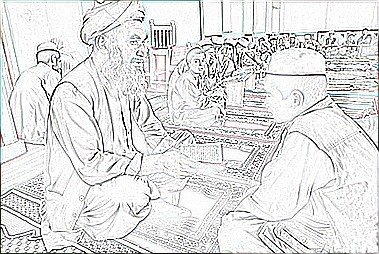



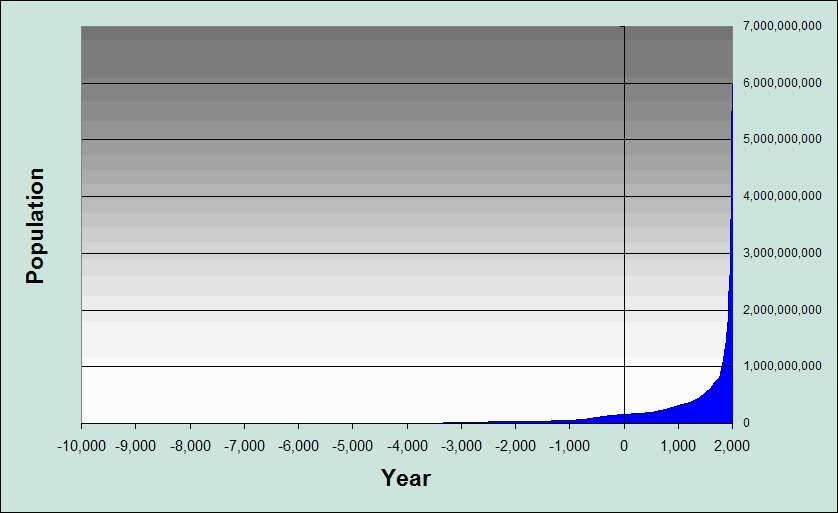
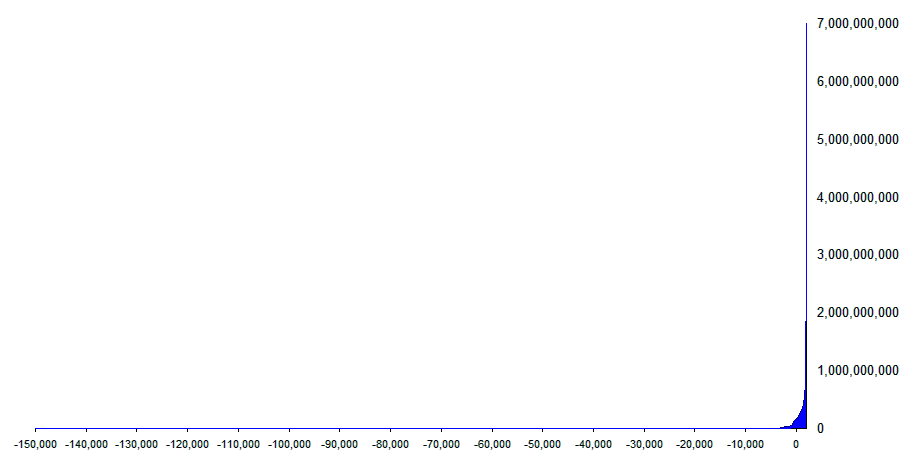
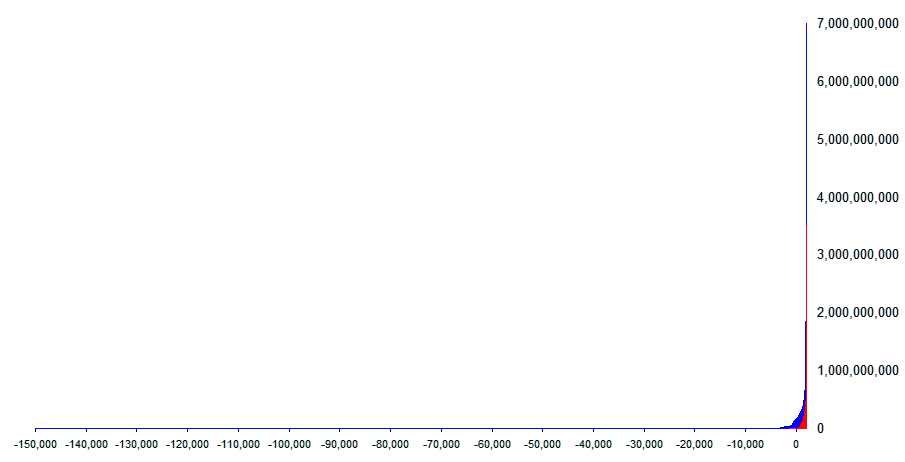
 )
)



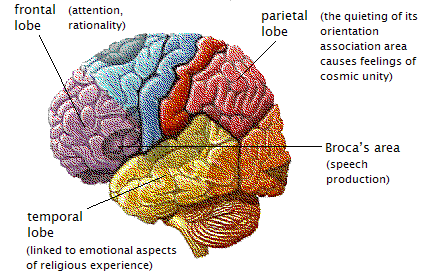
 Ha, ha!
But, that aside, your experiment — and even the idea to conduct
such an experiment — is ingenious, truly brilliant! If what you’re
reporting is true, I would venture to ask researchers who conduct
experiments on such matters to include other — and healthier!
Ha, ha!
But, that aside, your experiment — and even the idea to conduct
such an experiment — is ingenious, truly brilliant! If what you’re
reporting is true, I would venture to ask researchers who conduct
experiments on such matters to include other — and healthier!




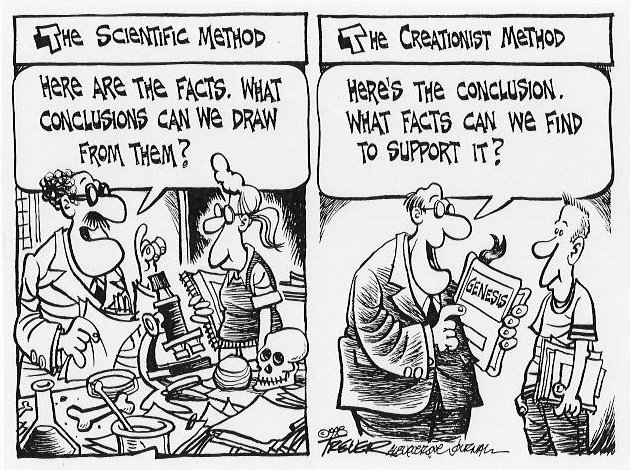
|
 |
|
Scientists will of course agree with the statement on the left, because there is nothing more unscientific than having beliefs and opinions that are not founded on observations, i.e., data.
Some religious people, however, might disagree with the statement on the right, because they are of the impression that they base at least some of their beliefs on data and observations. What they miss is that what they call “observations” and “data” are either (1) mere opinions of other people, not real data, or (2) not truly elementary data but interpretations (according to their beliefs) of elementary data; in other words, they are theories that attempt to explain the data. Here is an example of case (1):
Islam, which is one of the major religions of the world (in terms of number of adherents), claims that the holy books of Christianity (the New and Old Testament) and of Judaism (the Torah, which includes several of the books of what Christians call “the Old Testament”) have been changed in content and are thus corrupt; i.e., their original content as given by God was different, but people corrupted the texts as time went by. Hence — Muslims claim — their Qur’an represents the true and uncorrupted word of God (Allah). Although it is a fact that there have been some changes in the texts of the Bible, as the scribes that copied them throughout the centuries (before the invention of typography) made some errors while copying, however, there is not a single shred of evidence showing that the books of Christianity and Judaism have been changed as drastically in content as it would be necessary for the Qur’an to be correct. Rather the opposite is true, judging from the most ancient extant texts of the Old and New Testament, which predate the Qur’an: compared to them, the Qur’an appears as if it is their caricature — as if Muhammad, the author of the Qur’an, asked scribes to write down whatever he could remember from the Old & New Testament by heart, omitting important parts, having serious gaps in his knowledge of those books, and as if he was illiterate, unable to read them so as to refresh his memory. (Muhammad’s illiteracy, by the way, is something the Muslims agree on.) But Muslims believe the exact opposite: that the Qur’an (the newcomer) is the correct text, whereas the Bible (predating the Qur’an) is the corrupted one. Muslims fail to realize that this is a mere opinion of theirs, not based on evidence. When they are asked why they believe so, they reply that the answer is in the Qur’an itself; and why is the Qur’an correct? Because the Qur’an — they say — is the word of Allah, and that’s where the questioning must stop. In other words, their belief that Allah recorded his word in the Qur’an is primary; everything else is a derivative of that primary belief.
Now here is another, well-known example of case (2):
The religious person observes the stars one dark, moonless, starry night, and — awestruck by the magnificence of the spectacle — concludes that a supernatural power, namely God, must have created all that magic. Religious people use the awe, which the starry sky causes them to feel, as their basis for the conclusion that an intelligence far greater than the human one must be responsible for what their eyes witness.
The elementary data in this case is that which our eyes witness; i.e., the stars. The awe is not an elementary datum, but rather a subjective feeling, which some people experience but others do not; in any case, the awe is a psychological phenomenon, not part of the objective world of data out there. Finally, to reach the conclusion that God must be the creator of the universe the religious person makes two more hidden assumptions: (a) that something ordered and complex (such as the stars) can only be created by something which is even more ordered, complex, and intelligent; and (b) that the Higher Intelligence that created the stars is the God they believe in. Both (a) and (b) are not necessarily true: (a) is demonstrably false, and (b) is a logical non sequitur. Specifically regarding (a), ordered structures appear out of simpler ones all the time in nature. One such example is the various crystals, which are ordered structures that were created out of unordered matter by the application of purely natural forces, following the laws of physics as we know them (see the pictures that follow). But even the stars themselves were created out of unordered interstellar dust by mere application of physical laws, as we are now in a position to know. So there is no need to insert a Higher Intelligence into the picture of star creation. At best, such an Intelligence could be introduced to “explain” the specific laws of physics that we witness in our universe; but given those laws, the stars are a natural consequence of them. And regarding (b), even if our universe was designed by a Higher Intelligence with its specific laws of physics as we know them so that one day we humans could exist, it simply doesn’t follow logically that that Higher Intelligence is the God that most people in the world (Christians and Muslims) believe in. It could be a Higher Intelligence who enjoys creating universes in a Super Lab, doing it as part of an experiment, but who has none of the other properties that religious people attribute to God (omnipotent, omniscient, all-loving, all-merciful, etc). Thus, whereas the true data are what our eyes see (i.e., the stars), the religious person misuses the true data concluding an unwarranted conclusion about the existence of the particular god they believe in.
 |
 |
|
| Various natural crystals: green calcite, white
fluorite, cubes of pyrite, & white natrolite (part of the author’s collection). |
A hexagonal crystal of ice that landed on the
windshield of the author’s car one winter day and was captured by his camera. |
|
|
||
From the above fundamental principle a second one follows, in which science and religion come to a headlong clash:
|
|
|
It should be quite clear, I hope, that the above conflict of principles is a consequence of the one mentioned earlier. If, from the scientific point of view, observations (data) are primary and beliefs must be grounded on data, then it follows that beliefs are dependent on data. No belief can be considered absolute, or eternal, because new data might cast doubt on it in the future. In contrast, from the religious point of view, since beliefs are primary, they form the “axioms” of the religious belief system, and as axioms they cannot be questioned.
The idea that religious beliefs must remain unquestionable has cost, at times, the freedom, or even the lives of freethinkers. Among the well-known historical cases is the one of Italian philosopher Giordano Bruno, who was burned at the stake in 1600, found guilty of heresy by the Roman Inquisition of the Catholic Church. Bruno supported the heliocentric system, which contradicted “the spirit of the scripture”, as the Inquisition declared. Thirty-three years later, another Italian, Galileo Galilei — a figure of highest eminence in the history of science — was threatened by torture for the same reason and by the same Inquisition, and was forced to recant his beliefs and stay under house arrest for the rest of his life. Nearly 1000 years earlier, the founder of a new religion, Muhammad, would butcher and torture to death anyone who disagreed with him or mock his beliefs, as reported in the Islamic holy scriptures (the various “ahadith”). Muhammad’s way of dealing with dissent is, unfortunately, followed in our times by fanatics of Islam, who murder those who disagree with them or criticize their religion. In general, the idea of “death for disagreement” seems to be one of the ways in which religion copes with dissent; another, milder punishment, has been the excommunication from the Church — especially in Christianity.
Interestingly, the idea that there are no absolute certainties in science is not always fully appreciated by scientists who have only a superficial scientific training. For example, suppose that we let free a body heavier than the air near the surface of the Earth. What is our certainty that — banning a magician’s act or other trickery — the body will fall downward? One who is not well versed in the philosophy of science might answer that we have a 100% certainty that the body will move downward (toward the center of the Earth) because of “the law of gravity” — thinking that a “law” of physics cannot be violated. But in reality we are not allowed to have such an absolute certainty. Our certainty is extremely high, bolstered by all the objects that fall downward daily, as well as the many more objects that simply stay put on the surface of the Earth and don’t suddenly shoot themselves in a random direction toward the outer space; and yet, our certainty cannot — should not — be absolute. A “law” of physics is only our temporary shorthand description of a large number of observations (an extremely large number, in the case of gravity), and as such it might be found to be incomplete in the future. After all, the law of gravity itself, as expressed by Newton, was later found to be incomplete by Einstein, who expressed it in more accurate terms. This does not mean that, according to Einstein, an object let free can move not downward but in another direction; but it does imply that we only have a “not yet falsified” mathematical expression, which we call a “law” (of gravity). In principle, it might be that under certain unknown and not-yet-experienced conditions, gravity can be locally “reversed” and objects can fly away from the planetary center. No one can ever be absolutely sure about anything in science, which is an empirical business, meaning that it is based on observations, not on immutable “laws”.
A third fundamental idea follows logically from the above, and differs between science and religion: it says that in science we must seek the falsification of every theory, rather than merely its support by evidence. In contrast, in religion, neither the support, nor — much less — the falsification of beliefs is sought; beliefs are simply given, and remain unquestionable. (When there is “internal” questioning and an attempt for even a mild change of beliefs, the minority opinion is termed a “heresy”, and the dogma-changers “heretics”; whereas when people outside of the specific religion pose questions, they are simply called “unbelievers”.)
Given the above observations regarding the fundamental principles on which science and religion take diametrically opposite positions, one wonders how it can be that some people — whether trained in science, religious, or both — see no conflict and no overlap between the two domains. (E.g., see Gould’s idea of NOMA’s — Non-Overlapping Magisteria — in §3.1.) For example, religion makes some claims about nature: how the world was made, when it was made, how humans and all living beings were created, and so on. Religion starts from beliefs, which are enshrined in “holy books”. Science also makes claims about nature, but it starts from observations, and reaches conclusions that, at least on a first reading, seem different from those of religions. Some religious people claim that some parts of science are wrong (e.g., the theory of evolution); others try to interpret their holy books so that they do not conflict with the scientific observations — a not-so-easy endeavor, with no universally accepted solutions. But, as long as there is discussion, no one should deny that a conflict exists. As another example: religion is still considered, by many, as the only authority on moral values, the idea being that morality comes from God. Yet scientists, in our times, have started questioning this received wisdom, and explore the origin of morality, finding it elsewhere; specifically, in nature (see §2.1; also, see Sam Harris’s “The Moral Landscape” [31]). How can we deny that there is a conflict here? A third example concerns the notion of “soul”, which is of fundamental importance to most religions. According to many religions, souls keep existing after death, and/or will be summoned during an ultimate “Judgment Day”, or will enter and live in different humans or animals in the future, and so on. But science, and specifically cognitive science, explores human cognition and finds a different “story” as more plausible: what we perceive as “soul” is an emergent property of a single, but extremely complex, self-referring concept: the concept of “self”. (E.g., see Douglas Hofstadter’s “I Am a Strange Loop” [29].) How can there be no conflict when science (some relevant disciplines of it, anyway) and religion (almost all of it) disagree on such a fundamental idea, such as the nature of “soul”?
I think that to deny the existence of not just conflict, but conflicts between science and religion requires us to be self-blindfolded, or uninformed, or both. And I state this not because my thought is imbued by a polemical attitude, but because I do not find it fair to close my eyes to the existence of opposing views and their consequent contradictions.
4.3.1 Religious Dishonesty: How Creationists Misrepresent Scientific Theories
This topic will be further developed in the future like the rest, but meanwhile the reader is referred to a separate discussion of it in this page by the same author.
5. Dangers from Science
5.1 Is Science Another Religion?
5.2 A Thought Experiment: What if Religion Vanishes and Science Remains?
Footnotes (clicking on the caret (^) on the left of the footnote brings back to the text)
(^) Yes, yes, I know, some religious people believe that the whole world was created some 10,000 years ago. Others admit that the Earth was created around 4.5 billion years ago, as modern science assures us, but that our species is at most 10,000 years old; thus they accept science where it doesn’t matter much to them, but reject it where they think it doesn’t suit them. (I’ve had lengthy discussions with such people in the past, so I have a first-hand experience of conversing with those who accept science selectively.) For those whose temporal horizons of the past are shrunk like that... what can I say... they’ll get over it. People in the past have believed much more incredible things: that the Earth is flat, that it is at the center of the universe, that the heaven is a crystalline dome that holds and separates “the waters which [were] under the firmament” from those below it, and so on. Eventually the scientific knowledge becomes the layperson’s knowledge, but it takes whole centuries for that to happen.
(^) Muslims have expressed to me the opinion that the Allah of Islam is a better-conceived notion (“more perfect”) than the Christian God, because Allah has no gender, is neither Man nor Woman. Yes, it might be true that Allah has no gender in a Muslim’s mind, but this might be a simple consequence of the fact that Arabic, the language of the Koran (Qur’an), as well as nearly every language where the Islamic religion dominates, does not have grammatical genders. Thus, Muslims are not in need to say He or She when referring to Allah, because the concept of grammatical gender does not exist in most of the languages they speak. But most Christians speak Indo-European languages, which happen to have an obligatory grammatical gender, forcing the speaker to use a pronoun with gender, such as He or She. (The option “It” for languages with a neuter gender would be considered disrespectful when applied to God.) As a case in point, in Modern Greek, even proper names require a definite article with gender; so, Muslims who speak Greek are forced to say “o Allah” (“the [masc.] Allah”), using the masculine article, because omitting the article means speaking ungrammatical Greek, and choosing the feminine article (“i”) or the neuter one (“to”) seem even worse options. Thus, the issue of God’s gender is largely of linguistic nature, and should not be a reason for bragging about one’s own religion.
(^) It was brought to my attention that some people use the word “religion” so as to include even non-believers. For example, they claim that atheists and even agnostics are religious, as long as they hold some opinion about the existence, or non-existence, or even ignorance of existence, of God. In other words, whether you like it or not, you are religious. They do this by applying their own definition of the concept “religion”. Some people enjoy playing the “what is your definition?” game. I would like to make it clear that I do not find the discussion on the definition of religion particularly productive or illuminating. There are some so-called definitions that end up defining as religious only those people who subscribe to a particular creed (e.g., Christianity). Other “definitions”, as I mentioned, are so inclusive that they include practically every set of beliefs as a religion. What good is a definition that includes everything? I think that the only purpose of an all-inclusive “definition” is to satisfy the religious person’s ego in being able to claim, “Ha! See? Even those who say they are non-believers, are actually believers!” I find this attitude merely childish. A better view toward a definition of religion is described here, where a list of criteria for characterizing a set of beliefs as religion is provided (from the Encyclopedia of Philosophy), suggesting that some belief systems might satisfy some, a few, one, or none of the criteria. Thus there can be a gradation to how much a belief system qualifies as a religion.
(^) How do we know this? There is no direct evidence that no animal other than humans can conceive of the remote future, because it is extremely hard to set up a cognitive experiment in which a task is repeated, e.g., once every two years, and test whether some animal learned to anticipate the future occurrence of the event after some decades of training. (Who could be the researcher that would receive a grant for this sort of never-ending research! However, this doesn’t mean that research on this subject through different means is absent.[23]) But an indirect argument seems to be persuasive: animal species do not develop abilities just for the fun of it, but because there is some environmental pressure that causes them to evolve so as to acquire the ability and survive in spite of the pressure. (This is true of every living kind, not just animals.) For example, giraffes got their long necks not because they enjoy watching the world from high, but because the vegetation they feed on in the African savannah includes some very tall trees, and giraffes specialized in feeding on those. Now, there does not seem to exist some physical event that repeats periodically on our planet with a period longer than a year and shorter than an animal’s life, the perception of which would be beneficial for the survival of the animal. Even aperiodic events, such as the randomly timed deaths of relatives and peers, do not seem to work: how would an animal benefit and leave more descendants by knowing that its peers will die some time in the remote future?
Here is a hypothetical concrete example: there are some cicadas, such as Magicicada septendecim, which appear once every 17 years in some places in North America; if there were some brainy apes living in places where these cicadas appear, and the apes fed on them, perhaps this would be an example of an environmental pressure for the apes that could cause them to evolve so as to conceive of the remote future, with a temporal horizon of at least 17 years; but there are no apes other than humans, nor other indigenous brainy animals in the New World.
Thus, there is no environmental pressure to cause an animal with sufficiently large brain to need to think about the remote future. As for humans, we must have developed our ability to conceive of the remote future as an “added bonus” — if it can be called a bonus at all, causing us the fear of death — because we developed other, more fundamental cognitive abilities.
(^) It is often said that Stalin was an atheist. Yes, but “by fashion”, not “by conviction”. Stalin is not known to us because he was an atheist, but because he was a ruthless military and political leader, who caused a well-documented genocide (of the Ukrainians, by starvation), sent his political opponents to die in forced-labor camps in Siberia, but also saved Russia from succumbing to the Nazi onslaught in WWII. If he was an atheist, this is because he “ought to”, as a good communist, since communism was at odds with every established institution that supported the old Tsarist regime in Russia — and that included the Church — and since he was heavily influenced by Karl Marx, who had denounced religion as “the opium of the people”. As an atheist, Stalin was completely clueless. His knowledge of religion could not include even 1/100th of what is presented in this humble article, simply because most of what is discussed here was unknown back then; and also because Iosif Vissarionovich Dzhugashvili (a.k.a. “Stalin”) had hardly had any time in his upbringing to delve into the subtle philosophical nuances of religion and atheism.
(^) Or, if you will, the explanation exists, but it is probabilistic, and usually beyond the layperson’s grasp. If you toss a coin 1000 times, chances are that you’ll get approximately 500 “heads” and 500 “tails”. Let’s say that “heads” is good, e.g., you receive one meal for each “heads”, whereas “tails” is bad: you pay one meal per “tails”. Overall, after 1000 tosses of the coin, chances are that either you receive a small number of meals (you are a bit “lucky”), or you administer a small number of meals (a bit “unlucky”). But if 1000 people repeat the same experiment, chances are that one or two of them will get a very small number of “tails” and mostly “heads”: they will be the very lucky ones; likewise, one or two people will get a large number of “tails” (the unfortunate ones). The larger the sample of people, the greater the chance that there will be some very unlucky person, maybe someone who would need to pay in meals more than this person’s entire property. In a community of 1,000,000 people, you and others would be talking with pity about the misfortune that befell that poor fellow, and would be trying in vain to find an explanation in terms other than the theory of probabilities. But there is no need for another explanation. All one needs to understand is elementary probabilities, and how the dice of life happen to be sometimes too good, and sometimes too bad, for a few people. Our attention is usually focused on those few, and we ignore the bulk of those with less spectacularly good or bad luck.
(^) God was good for us of course, the believers, the authors of the story. For the others, our God would annihilate them without further notice. The morals in those times were such that the ancient Jews could not find any fault with the idea that “our God is helping us to wipe out a neighboring tribe, including their newborn babies, their mothers, and elder people”. So they attributed their ancient genocidal acts to their God. The notion that God cannot be so mean to kill the infidels — or help us kill them — is too modern, and has not even been digested very well by all people on this planet, since genocides in the name of a god continue to happen. More on the evolution of morality in this subsection.
(^) The creation myths of most ancient religions appear naïve to rational thought. For example, the ancient Greek creation myth talks of an initial void, in which there was only Nyx (Greek for “Night”), personified as a bird with black wings. Nyx then laid a golden egg, out of which came Eros, the god of love, etc., etc. But who created Nyx? Where did that come from? Similarly, the ancient Jewish creation myth (inherited by Christianity, and copied inaccurately by Islam), starts with God, who created the heaven and the earth. But who created God? Where did that come from? Contrary to common sense, adherents of Judaism and its descendant religions do not seem to even consider this as a logical question. Now, one might think that it is only the religious mind that falls into the trap of believing that there is a total explanation of creation, when in reality no explanation can be self-sufficient (since every explanatory system must be based on some initial assumptions). However, even modern scientists do not seem to be immune to this mental glitch. Theoretical physicists, for example, seek the ultimate formula that would explain everything — a “theory of everything”. But what would explain the properties of the fundamental elements in such a formula? This question is further discussed in this page of mine.
(^) Contradictions exist, for example, where religious texts report information that contradicts modern science. Anticipating the fervent protest and rejection of this idea by some religious readers, I will only make a short list (for brevity) of such contradictions, restricting myself to Genesis of the Old Testament, and pointing out that what is interesting is not so much the existence of the contradictions themselves (they can only be expected, since the texts were written by ancient peoples lacking modern knowledge), as the eagerness with which the religious mind is self-blindfolded, being in denial of the existence of contradictions, and finding the most ridiculous and irrational “explanations” for why these are not contradictions, after all. My short list follows:
- Right from the start, God creates some things out of order: specifically, first the Earth (Gen 1:1-2, first “day”) and then — much later — the stars (Gen 1:14-15, fourth “day”), whereas it is now common knowledge that stars predated our Earth, Sun, and solar system by several billion years.
- During the second “day”, God creates the “firmament” (Gen 1:6), which he calls “Heaven” (Gen 1:8), in order to divide the waters which were under the firmament, from the waters which were above the firmament (Gen 1:7). Here, the ancient Jewish world-view is so transparent: the firmament/heaven is a dome that separates the waters under it (the oceans and seas) from the waters above it; that’s why the sky is blue folks, because there are waters above the firmament; and when it rains, obviously it is those waters that pour down on earth (as confirmed in the deluge story, Gen 7:11, where it is said that the aqueducts of the sky were opened). Yet this so patently obvious — and cute! — ancient interpretation of the natural world is vehemently denied, or at best ignored, by the present-day staunch believers of the Jewish and Christian religion.
- God creates grass, other plants, and even fruit trees (Gen 1:11-12, third “day”) before the Sun (Gen 1:16-17, fourth “day”). How could plants survive and grow for a whole “day” without sunlight, unless the so-called “day” was literally a 24-hour period, or a very short interval of time? (But that would contradict most of scientific knowledge, since we know that the world wasn’t created in a few days, but in around 13 billion years.) A religious fundamentalist once offered to me the “explanation” that the light that nurtured the plants in day three was the ambient light created in day one, which in turn was presumably the light created during the early stages of the Big Bang. Such “explanations”, though sounding impressive to the layperson, are totally lacking in scientific basis: by the time our planet was formed, the ambient light of the Big Bang had already turned to radiation that’s invisible to the eye, and unsuitable for causing photosynthesis in the chloroplasts of plants.
- The very creation of the grass, shrubs, and trees, contradicts what we now know: God did not need to resort to a miracle, creating plants in some special way, because nature has a very effective and natural (as opposed to supernatural) way by which it brought them forth: plants evolved from bacterial life. In some countries, e.g., in the U.S.A., religious fundamentalists spend an unbelievable amount of energy trying to refute the scientifically obvious: that evolution happened (and keeps happening). This attitude of religion against science has occurred repeatedly in the past, most notably when the Christian Church burned people on the stake for opposing the official view of the Church that the Earth is at the center of the world, and the Sun, Moon, and other bodies orbit the Earth. (How many times does religion need to be proved wrong before religious fundamentalists finally get it that they are the wrong sort of folks for issuing judgments regarding the natural world?)
- Nor do stars require any special (miraculous) way in order to form; we now know exactly how they are formed, by the laws of physics (see here). Also, the stars were not created once and for all during some “day”, as the Genesis text suggests, but kept being formed throughout the “creation”, unabated. Stars are being formed even today (unabated), nearly in every corner of our galaxy (as in every galaxy), and one can view spectacular pictures of stars at every stage during their formation, taken by the Hubble Space Telescope. Thus, the idea that there was a specific time at which the stars were created is completely out of touch with reality.
A reader expressed the objection that the Hebrew verb used for “created” is bara´, an imperfect indicative active, thus indicating an action that began in the past and still continues... God keeps creating (even stars), according to this reader. But the problem is not with the tense and aspect of some verbs in Genesis. The reader misses two points: first, if God created and keeps creating, then what sense does it make to pinpoint the star creation at a specific “day”, such as the fourth one? Why not the first (as would be more fitting, since of all things mentioned in Genesis 1, star formation is a process as old as nearly the entire universe)? And second, does God really create stars? Why would anyone who has understood the physical processes behind star formation believe that God does it? Does any educated person today believe that God creates the raindrops? No, right? Then why would God create “gravity-drops”, or stars, as we commonly call them? Of course, if one doesn’t know much about clouds, what they are, and under what conditions raindrops are formed, one is prone to attribute rain to God (“If, then, you truly heed my commandments [...] I will give the seasonal rain to your land, the early rain and the late rain [...]” [Deut. 11:13–14]). Similarly, today there are many people who have no idea how stars are formed, so they attribute their creation to God. Please read at least the explanation of how stars are formed in the present text, in this section.
- God creates animals only during the fifth and sixth “day” (Gen 1:20-25), whereas plants were already present since the third “day” (see above). But we know that plants and animals evolved essentially together out of microbial life: photosynthetic eukaryotic (= “with nucleus”) cells made up colonies that became the precursors of the first plants; at nearly the same geological time, “animal” protists (eukaryotic cells living by attacking and engulfing other cells) formed colonies, the precursors of the first animals. Clearly, to claim that a whole “day” (the fourth) intervened between plants and animals (a day involving the creation of stars, Sun, and Moon, to boot), is a gross contradiction with modern knowledge.
- God creates even whole classes of animals in the wrong order: the serpents (reptiles) are created in “day” six (Gen 1:24-25), but the birds, which we know evolved from the reptiles some time in the upper Jurassic period, are created in “day” five (Gen 1:20-21).
(^) An example of modern, and even dangerous religious nonsense, is the position of the Catholic Church that contraceptive devices (condoms) should not be used, because they work against God’s order to humankind to multiply; never mind that this religious directive acts as a death squad, sending human beings to their death by AIDS (see more in another footnote(*)). Nonsense in the Islamic world includes (but is not limited to) the treatment of women, who, in countries such as Saudi Arabia, cannot vote, cannot drive, cannot be educated formally, cannot go out of their home without being escorted by a man, when they do so they have to be dressed like a sack of potato, and are severely punished if any part of their body is revealed in public; in addition, the testimony of two women in court is equal to the testimony of a single man.
(^) Not to be confused with the more common use of the term “intellectualism”, meaning the devotion to and praise of the powers and development of the intellect, which is strongly associated with “elitism”. This has caused the emergence of the movement of “anti-intellectualism”, which is synonymous with “egalitarianism”. All this is unrelated to the notion of anthropological intellectualism.
(^) For philosophers, perhaps this is a problem to ponder on. For cognitive scientists, however, I beg to disagree. Being a cognitive scientist, I don’t want to give the impression that I react as en expert who feels compelled to give an answer even though he doesn’t have one, but this problem in cognitive science is really elementary. The problem exists only when we mix up the software and hardware levels of description. Think of the computer analogy. A program can cause a peripheral device of the computer to move (e.g., a printer, a hard disk), and if the program is sophisticated enough, it can do this without having been explicitly programmed by the programmer. (The head of my computer’s hard disk moves at unanticipated intervals all the time, without my direct control of it, and its motions are meaningful, not erratic.) How can the immaterial software move anything physical? Well, if we stay at the level of software of course we have a conundrum. But the software that does this has a hardware correlate: the bits of information that are physically realized in terms of zeros and ones in the computer’s memory. Bits are both software (0 and 1, abstractly) and hardware (whichever physical way they are realized in a computer chip, or CD/DVD). It is the hardware bits that make the computer peripheral move, and it is the organization of the bits, along with the supplied electrical power, that cause the peripheral to move in a meaningful way. Similarly, thoughts have correlates in the neurons of the brain, though the neuronal correlates are probably even more non-obvious and opaque than the hardware bits. It is the neurons that move the arm of a person, and it is their organization that makes such a motion meaningful to us.
(^) Exactly the opposite is true: mountains are the “wrinkles” of our planet precisely at the places where it trembles and shakes: in the vicinity of current or prehistoric seismic faults, where the tectonic plates meet; but Muhammad and his followers did not live in Australia or Siberia to realize that the Earth is mountain-less exactly where earthquakes are practically never felt.
(^) Unsurprisingly, most Americans do not seem to be aware of this feature of their culture, judging from my personal experience with them. Some examples of black-and-white thinking in American life are the following:
- There is Good and Evil in the world. We are on the side of Good, and we have some traditional allies on our side (losing them one by one recently, for unknown reasons). All others are on the side of the Evil, represented by the Axis of Evil: North Korea, Iran, and Syria, as our President declared in 2005. (The list can change in time, but it is imperative that there be a list of Evil-doers).
- Our President said it eloquently, immediately after 9/11: “Either you are with us, or you are against us!”
- Every person can be assigned a proper race: either someone is White, or Black, or Hispanic, or Asian, etc. So we can always tick in the appropriate box on forms when we are asked to supply our racial background.
- Every person can be assigned a proper gender: male, or female (so no problem again ticking the appropriate box). Never mind that there are transgender people, who may think that their bodies disagree with the gender to which they feel they belong; or asexual people, who cannot (or feel reluctant to) assign themselves to either of the two biological sexes; or hermaphroditic people; and more.
- Every living being either has a soul or lacks one.
- After death, the soul goes either to Paradise or to Hell.
- Either you win a championship, or you don’t. Nobody ever remembers those who competed for the second or third place. Besides, when you enter a competition, you enter in order to win, not simply to compete. (What a ridiculous idea, “simply to compete” — ha, ha!)
- In life, there are two kinds of people: the winners, and the losers. Either you work hard in your life to be with the winners, or you don’t, and you become one of the losers. What would you like to be, kiddo, winner or loser?
For a concrete example, consider this one: in 2004, a 12-year-old boy in Ohio won the right in court to wear a T-shirt to school bearing the words “Homosexuality is a sin, Islam is a lie, abortion is murder. Some issues are just black and white!” (In [13], p. 23.) There are more examples, but this is not a survey on the American psychology, so I’ll cut the list short. And, no, I didn’t get the above ideas about Americans “from the movies”, as a correspondent of mine thought. First, I seldom watch movies, and second, I got my ideas by direct observation, having lived for over a decade in the U.S. However, if you are an American, you don’t necessarily need to be pigeonholed into the stereotype that I describe above. There are always exceptions to the rules.
(^) I put the word “want” in quotes because, naturally, memes do not have any volition; they do not really seek anything, any more than real viruses seek anything. But the functioning of viruses makes them appear as if they want to spread and infect people. A virus doesn’t have a brain, it’s a tiny scrap of DNA. But evolution has honed viruses so that, e.g., some of them cause us to sneeze, so they look as if they do everything they can to transfer their residence from person to person (because those viruses that didn’t do such tricks, aren’t around — they have been eliminated by natural selection). Similarly, a meme doesn’t need to think “I want to be transmitted” — it can’t think anything. But some sort of natural selection has kept in our minds those memes that are good at being copied from mind to mind. Those memes that are not good at that are absent from our minds, since we didn’t receive them from others. So, memes too, like viruses and genes, appear as if they have volition.
(^) And because the world is large, and statistically every possible aberration will be observed given a large enough sample, please don’t write to me bringing to my attention some idiot atheist’s attempt to organize a mission, if there is any. Don’t lose sight of the forest, focusing on the tree. One exception will not suffice to annul the rule, which is that traditionally missionaries are religious.
(^) One might claim that the 20th C. communist regimes could qualify as institutions that sought the spread of atheism. There is a bit of truth, and a lot of detachment from reality with this idea. Communist regimes — specifically the metropolis of them all, the Soviet Union — sought to advance communism, not atheism. The latter was only the official dogma, a reaction to organized religion that the Bolsheviks in tsarist Russia had fought against. Also, the theoreticians of communism, Marx, Engels, and Lenin, had expressed their views against religion, so atheism was adopted as somehow the only officially possible stance against religion. But communists did not organize missions in Africa, for example, trying to convince African tribes that they should convert to atheism. Wherever “people’s republics” were established in Africa or Asia back then, atheism played essentially no role, because local tribes retained their local religions. (After all, tribe leaders established those “people’s republics” so that they could receive financial support from the Soviet Union, not because they had any ideological attachment to communism.)
(^) But if atheists are not interested in spreading their ideas, what am I doing here? Am I not spreading my “viruses”? I hereby sincerely affirm that spreading my ideas is not my purpose in writing the present text. If there is any spreading, I apologize — it should be construed only as a side effect. As I explained in the introduction, my purpose is to put my thoughts about religion in some coherent order, in an effort to understand the cognitive phenomenon of religion. (Recall that I am a cognitive scientist by profession, which I hope explains my interest.) I uploaded this text in the Internet seeking feedback from various sources — both believers and non-believers — not attempting to “convert” anyone to atheism. Personally I find the idea of preaching for conversion abominable.
(^) And this is very important, because measuring the age of fossils and the age implied by differences in the DNA structure are two independent methods. Whenever two independent scientific methods converge to roughly the same answer, this lends much stronger support to the conclusion than either one of the methods would provide in isolation.
(^) However, Joe did not have a clue about the actual number. He simply believed that it’s not just a few thousand years, or better yet, he believed he had no objection to the age of the Earth as announced by scientists. But when I asked him exactly how old he thought the Earth is, he estimated it to be some tens of thousands of years. Upon pointing out to him that it is actually around 4.5 billion years old, he replied, “Oh, well...” — with a taunted expression on his face, which I interpreted to mean, “Who cares... some tens of thousands, a few billion — what difference does it make?”. Like every good creationist, he was oblivious to the fact that even to begin to find evolution possible, familiarity with the actual age of the Earth makes all the difference in the world.
(^) It’s not just religions that failed to guess correctly the location of our origin; some scientific theories were not much more successful either. Lacking the evidence that accumulated recently, there was (in the 2nd half of the 20th century, and still appears in many textbooks) the theory of multiregionalism, according to which each type of people (Europeans, Asians, Africans, etc.) evolved independently from earlier, ancestor types of humans (the Homo erectus kind), and through interbreeding. The way I understand it, multiregionalism implies that our kind, H. sapiens, and the ancestor kind H. erectus are actually one and the same species! Otherwise how could the various H. erectus individuals in Asia, Africa, and Europe, evolve independently into the same kind of animal, the modern H. sapiens? There is not a single similar evolutionary example in the biological world. So, either we, humans, are somehow biologically special (able to evolve independently into the same species from geographically distant populations of an ancestor species — an impossible hypothesis), or H. sapiens is not really a new species but the same species as H. erectus, a conclusion that simply pushes the question of the origin of our species back in time by about 1.5 million years. However, multiregionalism is not supported sufficiently anymore by the paleoanthropological and molecular-biological evidence.[7] [8] [9] [10] [11] [30]
(^) The depth of the Red Sea at the Strait of Bab el Mandeb is deep enough to guarantee that it has always been a water strait, never converted to a land passage, even when the sea level was at its lowest (e.g., during glaciation periods, when large masses of water were accumulated on the poles). Also, we know that our ancestor species H. erectus did not possess the necessary skills to build rafts and travel any significant length over the sea. For example, H. erectus reached the islands of Indonesia (hence the “Java Man” fossils) because there were times during which the sea level had dropped, turning many Indonesian islands into parts of a connected land mass; so H. erectus individuals could walk over the land, but never managed to cross the Timor Sea, which separates Australia from Indonesia, and remained always a body of water.
(^) I use the term “farming” and “agriculture” interchangeably and in the general sense, which includes animal husbandry.
(^) However, just because most people in the world today would loathe to see the bodies of their relatives being consumed by scavengers does not mean that all cultures on the planet think the same. In Tibet, for example, a traditional way for dispensing the dead body is to leave it in the open for vultures to consume it, a practice known as “sky burial” (warning: the reader is advised not to follow the previous link if s/he suspects s/he would feel uncomfortable reading the article of the encyclopedia; at the very least, read the following explanation first). This practice is not without justification, and does not mean that Tibetans do not believe in the afterlife. It is precisely because they believe that the soul has departed from the body, that they regard the body as a lifeless object, and deem it best that it be returned to nature, where it originated from. Seen from the proper perspective, the practice makes rational sense, and cannot be relegated simply as “barbaric”. (Tibetans might think that, instead, the Western practice of burial is barbaric, for reasons that I do not need to explain, but are within everybody’s reach.) Thus, we see that avoidance of burial (as well as cremation) does not imply that some culture does not hold beliefs about the afterlife.
(^) This legend, which sounds so much like a plagiarism of the Great Flood of the Hebrews, is at least as old as the Jewish legend, so it is not possible to say which was plagiarizing which. More likely, none of the two is a plagiarism of the other. Mythological stories were memes floating among ancient cultures, through their mutual interactions. Thus, the Great Flood legend is found in the mythologies of several ancient peoples. Another Great Flood legend, most probably predating the Hebrew and Greek legends, and with many similarities to both, is the story of Ut-Napishtim in the Babylonian epic of Gilgamesh, ca. 2100 BCE.
(^) Some readers might object to my use of the term “Muslim nation”. Indeed, there are some nations, such as Nigeria, with a population split between Muslim and Christian beliefs. Also, there is one nation with predominantly Muslim population, Turkey, in which the death penalty has been abolished (though openly criticizing Allah, the Koran, or Muhammad in Turkey is not the wisest thing to do). However, in most other nations with Muslim populations, such as the Arabic countries, Iran, Pakistan, etc., speaking against Islam does incur the death penalty (so nobody does it), and that is what I mean by “Muslim nations”.
(^) Today, when it is people who perpetrate such an act, we call it a genocide. But when it is God who does it, then it’s called “Divine Justice”.
(^) Why is this story, in my opinion, morally unacceptable? Because it is perceived as horrendously frightening by some children: it ruins their trust in their parents, which hasn’t become rock-solid yet with all the things we learn about our parents later in life. I am speaking from personal experience: I admit I had a hard time swallowing this story as a 7-year-old child, the time when I first read it, and I’m sure I wasn’t the only child in the world who had this reaction. I identified of course with poor Isaac, and couldn’t digest the idea that a father could raise a knife and slaughter his own little son — and this was presented as virtuous in the book! Really, is it a virtue to agree to slaughter your child because the Führer of your tribe asked you to do so? When the young mind is still uninjured by the religious infection it can see this act for what it is: the molesting of a powerless and inferior (child Isaac) by the powerful and superior (father Abraham, or even God himself, since he gave this horrible command to Abraham). That was the first time I felt something is deeply rotten in the book my parents gave me to read.
(^) Genocidal: Gen 6:5-8:22, Gen 19:12-28, Num 31:1-10; Josh 6:13-27; misogynist: Gen 19:8, Jdg 11:30-40, Jdg 19:23-29; jealous bigot: Exd 34:14. These are not the only derogatory epithets that befit the O.T. God, but I don’t want to appear as if I am motivated by ulterior motives of hatred against religion, so I include here only what can be indisputably(*) attributed directly by the biblical text. (*) Indisputably only if one’s mind is not infected by the religious memes, which have the capacity to make one see black as white, and vice versa — more about this in §3.3.
(^) This statement is meant to be understood as applying only at the interpersonal level (among individuals), not at the international one (among nations). For example, at the time of this writing, European nations (including some that are aspiring members of the European Union) have abolished the death penalty; the United States, however, regularly executes criminals on its own soil (the U.S. is among the champions in capital punishment, together with China, Iran, and North Korea), and non-American civilians elsewhere in the world (e.g., most recently in Iraq, under the pretext of warfare). Apparently, the average American does not feel immoral or even responsible for the human lives lost due to their nation’s offenses against other nations, or for the ease by which convicted fellow Americans are executed; but they do employ modern morality when it comes to interpersonal relations.
(^) This is not meant to be interpreted as saying that every member of her culture is arrogant. Clearly, there are many humble Americans, and I have had the pleasure to interact with quite a few of them over the years, including some of my best friends. The characterization “arrogant culture” should be construed only in a statistical way.
(^) I call circular reasoning the attempt to explain morality through morality (ours through God’s). One might claim this is not circular reasoning, strictly speaking. Okay, but it is logically very unsatisfying, unconvincing reasoning. It’s like trying to explain the shaking of the earth during earthquakes through the shaking of an underground deity who occasionally sneezes. The question is whence cometh morality; not our human morality, but morality in general. When they tell me: “Morality comes from God”, they explain to me the origin of human morality, but not of morality in general, because they have no idea why God is moral and not immoral; they simply take it as an axiomatically accepted fact that God is moral.
(^) Okay, fine, there is also the possibility that God could be indifferent to evil or its absence, or that he could display a mild interest in morality (like Zeus, for example), and so on. My purpose here is not to examine all possibilities exhaustively, but to present the diametrically opposite alternative to the predominant religious view of today, which admits only one possibility: that God is good.
(^) Sometimes it is possible to prove mathematically a few properties (usually trivial, though) of chaotic systems, but much more commonly, proofs are impossible. In some cases it has been proven that such proofs are impossible, so it is not merely our ignorance that prevents us from finding a proof. There is a good chance that the property I am interested in (whether species T would survive or be extinct) is such a typical property of a chaotic system, lacking a proof, because it is somewhat reminiscent of the “halting problem”, a famous “undecidable” (provably unprovable) problem of computability theory in computer science. In such cases, amassing evidence by repeatedly running the simulation of the system is the next best thing short of obtaining a proof.
(^) It might sound unrealistic that plants don’t die; and yet, it isn’t. I could make each plant stay at a location for a fixed number of epochs, then “give birth” to another plant with similarly restricted lifetime at another (random) location, and then die. But this is equivalent to a plant that moves randomly in space. Because animals also move randomly in space, it doesn’t make any difference after all if the animals will find the plants at their original locations or at different ones. This means that moving plants around doesn’t add anything of interest to the system.
(^) For example, Richard Dawkins was asked what in his opinion the origin of morality is, during the question-answer session of the presentation of his book, The God Delusion, in Lynchburg, Virginia. After first offering his well-known explanation of altruism based on the evolution of genes (see The Selfish Gene,[4] chapters 1 & 10), he ended up admitting honestly: “I don’t know”. (The entire lecture can be found online at this address.) In The Selfish Gene we read:
“I am not advocating a morality based on evolution. I am saying how things have evolved. I am not saying how we humans ought to behave. [...] My own feeling is that a human society based simply on the gene’s law of universal ruthless selfishness would be a very nasty society in which to live. But unfortunately, however much we may deplore something, it does not stop it being true. [...] Be warned that if you wish, as I do, to build a society in which individuals cooperate generously and unselfishly towards a common good, you can expect little help from biological nature. Let us try to teach generosity and altruism, because we are born selfish.” (pp. 2-3.)
On the contrary, I believe that help in understanding the origin of morality can come precisely from biological nature. Dawkins didn’t see it because he has focused on the leaves of the trees, and missed the forest.
(^) That species compete and some of them become extinct because of competition is a moot subject among biologists, but some evidence exists in favor of answering in the affirmative. For example, it is well known that marsupial mammals generally do not compete favorably against the placental mammals. For this reason, marsupials have been restricted mostly to the isolated continent of Australia, with a few exceptions only in South and Central America (and the single species of opossum in North America). Fossil evidence indicates that South America was once inhabited only by marsupial mammals, when the two Americas were disconnected. At that time (between 120 and 100 million years ago), South America, Antarctica, and Australia were all connected, forming one gigantic southern continent (what was left of the earlier and even larger continent of Gondwana), where marsupials were the only mammals. Later, when the isthmus of Panama was formed, placental mammals invaded South America from the north, and marsupials essentially vanished in the south — with only very few surviving in specialized niches, including the opossum, which is a remnant of the marsupial species of South America that migrated northward. Of course, the American marsupials weren’t extinct because they became a meal for the other ones, but because the placentals have better specifications for survival in the same environments. (Meanwhile, Australia was already disconnected from Antarctica, so its marsupials were saved from the placental invasion.) Thus, what we have here is an entire biological taxon competing against another: the subclass Eutheria (placental mammals) against the subclass Metatheria (marsupial mammals). At the species level, whenever placentals such as rabbits and foxes were introduced in Australia (by European settlers), they displaced completely the corresponding native marsupial species, and are now treated nearly as pests by the Australians. The “battle” of placentals against marsupials, although superficially appears unrelated to stealing and morality, is a clear example of competition among species (or even taxa) that can result in the survival of one at the expense of another.
(^) For the occasional reader who is unfamiliar with this issue, the Catholic Church opposes the use of condoms during sexual intercourse, thus condemning to death by AIDS thousands, if not millions of people, mainly in Africa and other under-developed places. (See also this footnote.) The Catholic Church’s rationale is that human beings should not intervene in God’s will, and so should not kill sperms, each of which is a potential human being. Unbelievable or not, the Catholic Church gives more rights to sperms than to fully developed adults, disregarding the fact that it’s not just sperms, but any cell of the human body that has all the information and potential in its DNA to become a human being. Come to think of it, following the Catholic Church’s logic, every time you scratch your head you commit a genocide of colossal proportions.
(^) Note that even the Levite’s servant was saved from the ordeal, presumably because he was male, and the old man’s maiden daughter was offered to the hungry mob instead, along with the concubine. I suspect that the ancient Jewish hierarchy in a household ran something like this: first the male lord of the house, then the male children, then the male servants, followed by the wives, female children, female servants and concubines, asses, and oxen. (I am not sure whether male asses and male oxen would be worth less than the wives and other female property, though.)
(^) In other words, Allah appears to give the following self-contradictory command: on one hand, “do not exceed the limits”, i.e., do not retaliate in a manner harsher than your enemy’s wrong-doing; and on the other hand, “kill them wherever you find them [because] persecution is worse than slaughter.” Really? Is persecution worse than slaughter? What would you prefer, to be persecuted, or to be killed? I bet that every sane human being would prefer to live, even under a state of persecution, rather than to be killed. So, either Allah made the incredibly stupid statement that “persecution is worse than slaughter”, or that statement was made by the illiterate “prophet”, the founder of Islam. In the first case, Allah appears to contradict common sense, and so proves to be dumber than the dumbest person. In the second case, Muhammad is simply wrong, for almost everybody would prefer to live rather than die; therefore slaughter is worse than persecution, therefore the Muslim who kills his enemy at war indeed exceeds the limits, contradicting the Quranic command of 2:190.
(^) If this “argument” hadn’t been posed by someone in an e-mail exchange that I once had, I wouldn’t consider it worthy of mention. And yet, someone suggested it in all seriousness! This idea is reminiscent of the following situation: say that someone that goes by the name of “Rasheed” is standing in front of a mirror, wearing terribly wretched rugs, torn to pieces, full of dirty spots. Suppose you tell him, “Take a look at yourself in the mirror Rasheed: you’re full of dirt!” Then he becomes indignant, and argues with you as follows: “Yes, but don’t you see that there are also several clean spots? Why do you disregard the clean spots when you say that my clothes are dirty?”
(^) It is interesting also that the word “men” in “all men are equal” did not bother much most people until very recently, when political correctness prescribed the use of “people” or “humans” instead of “men”, thus not excluding half of the human population. Still, many people do not see any problem, insisting that the word “man” in this case stands for all people; well, then, why not using “woman” to stand for “people”? If you are a man, how would this sound to you as a dictum: “All women are equal”, if you were told that in this case the meaning of “woman” is “all people”?
(^) Social Darwinism is the misapplication of biological (Darwinian) principles on human societies. Its only relation with real Darwinism (i.e., with biological evolution through natural selection) is the unwarranted use of Darwin’s name in its title, as its principles are not biological (natural), but human-made, suiting the needs of certain ideologies (usually fascist), and conflict with evolutionary principles on several counts (see this Wikipedia article for more details).
(^) I put “heart” in quotes to avoid confusion with the real heart, which is nothing more than a pump of the blood. I hope it is understood by all readers that when we say “feel it with your heart”, we mean “feel it with that part of your brain that deals with emotions”. The true heart has nothing to do with feelings. Simply, when certain feelings are involved, such as anger, fear, sudden love, etc., there is a lot of activity in some regions of the brain, which thus require more oxygen, and fast; the extra oxygen can be fetched only through a larger quantity of blood arriving in the brain per unit of time, which is accomplished by a faster heartbeat. Thus, strong emotions in the brain can cause the familiar flutter of the heart, which is what made people attribute feelings to the blood pump ever since antiquity.
(^) It’s comical only for our Western standards of knowledge, if any Westerner believes it sincerely. Once a professor of mine told me that when he served in a peace corps unit in Africa he met with tribes the people of which believed that the Earth is flat. That’s not comical. It’s not even “tragic”, if those people lived happy lives. It’s just that, with the data that are available to them, they have no reason to believe that the Earth is not flat. Ideas start becoming ridiculous, bordering on the comical, when we have accumulated enough knowledge and amassed enough evidence from independent sources supporting the contrary view.
(^)
Jaynes suggested (in [28])
that ancient peoples, before some time around 3,000 years ago,
could not understand that the inner voice of their thoughts was
their own, because the right part of their brains was generating
voices which the left part was hearing, without the latter being
able to tell that such voices were coming from inside of the
person’s head. That’s because, according to Jaynes, the human
mind was split in two, in a “bicameral” state
(whereas today the minds of people are assumed to be in a “unicameral”
state). Jaynes cites evidence from literature: e.g., in Homer’s
epics, the poet asks the Muse to sing to him, and although today
most people understand a “Muse” to be a mere personification
of the ancient bard’s inspiration, Jaynes contended that the
ancients were actually hearing a voice — which they attributed
to a Muse — singing the poems to them. He says that more
evidence comes from passages in the Old Testament in which
ancient people lament the fact that the gods, who were speaking
to them until that time, later remained silent; which is
explained by Jaynes as indicating that the minds of those people
were passing from a bicameral into a unicameral state. In the
Iliad, and in entire passages of the Old Testament, there is no
sign that anything like the mental state of introspection was
going on. Jaynes concluded from such observations that ancient
people with a bicameral state of mind were not conscious!
This is the wackiest theory of consciousness I’ve ever heard.
First, why is the ability for introspection what determines consciousness?
According to Douglas Hofstadter,[29]
consciousness is present, even in a minute degree, when the
individual (which can be an animal, or a human infant) has the
ability to entertain an internal (mental) symbol that represents
the “self”. It can be a “little consciousness” if the
self-symbol is poorly connected to other symbols, or a “larger
consciousness” if the self-symbol is richly connected; and all
the in-between degrees of consciousness are possible. Thus,
consciousness varies in degree according to Hofstadter (and I can’t
agree more with him), it’s not an all-or-none phenomenon, which
makes people either fully conscious or zombies! But, leaving
aside Jaynes’s messing up with consciousness, even his idea
that people who would hear disembodied voices would attribute
them to a god, or gods, sounds silly to me. First, when I hear my
inner voice while thinking, it always sounds masculine (if not
exactly with my tinge of voice), I never hear a woman talking to
me! So I would never attribute that voice to a goddess. So, how
could men believe in the existence of goddesses, and women in the
existence of gods? (Let alone children, who should believe in the
existence of only kiddie-gods.) Second, and more important, I
never hear that voice pronouncing whole sentences. It almost
always stops in the middle of a thought, goes back, restates the
thing, stutters, changes its mind again... If I were to believe
that this is the voice of a god talking to me, then I’d
conclude this god is a stutterer, and moreover, he’s a complete
idiot, because he never manages to finish a full sentence. And
third, if Jaynes were right, there should be people existing
today — perhaps in remote hunter-gatherer societies — who
retain the old “bicameral” state of mental functioning, since
no sane thinker should expect that the entire world switched to
the “unicameral” state of mind, magically, about 3,000 years
ago. (What exactly would the cause of this global switch be?) Why
hasn’t any anthropologist found such tribes, whose members
report hearing voices? Yet Jaynes managed to write a whole book
about that idea, and had it published.
References (in order of appearance in the text; clicking on the number brings you to the first point where the reference appears in the text)
[1] De Waal, Frans. (2006). Primates and Philosophers: how morality evolved. Princeton University Press.
[2] Hauser, Marc. (2006). Moral Minds: How Nature Designed Our Universal Sense of Right and Wrong. Ecco/Harper Collins Publishers.
[3] Boyer, Pascal. (2001). Religion Explained: The Evolutionary Origins of Religious Thought. Basic Books.
[4] Dawkins, Richard. (1989). The Selfish Gene. Oxford University Press.
[5] Blackmore, Susan. (1999). The Meme Machine. Oxford University Press.
[6] Dennett, Daniel C. (2006). Breaking the Spell: Religion as a Natural Phenomenon. Viking.
[7] Lewin, Roger. (1999). Human Evolution: An Illustrated Introduction. Blackwell Science.
[8] Leakey, Richard. (1994). The Origin of Humankind. Basic Books.
[9] Olson, Steve. (2002). Mapping Human History: Genes, Race, and Our Common Origins. Mariner.
[10] Cowen, Richard. (1995). History of Life. Blackwell Science.
[11] Diamond, Jared. (2006). The Third Chimpanzee: The Evolution and Future of the Human Animal. Harper Perennial.
[12] Diamond, Jared. (1997). Guns, Germs, and Steel: The Fates of Human Societies. Norton.
[13] Dawkins, Richard. (2006). The God Delusion. Bantam.
[14] Wilson, David Sloan. (2003). Darwin’s Cathedral: Evolution, Religion, and the Nature of Society. University of Chicago Press.
[15] Church, R. M. (1959). Emotional Reactions of Rats to the Pain of Others, in Journal of Comparative and Physiological Psychology. 52: 132–134.
[16] Wechkin, S., Masserman, J. H., and Terris, W. (1964). Shock to a conspecific as an aversive stimulus, in Psychonomic Science. 1:47–48.
[17] Masserman, J. H., Wechkin, M. S., and Terris, W. (1964). Altruistic Behavior in Rhesus Monkeys, in American Journal of Psychiatry. 121: 584–585.
[18] O’Connell, S. M. (1995). Empathy in chimpanzees: Evidence for Theory of Mind? in Primates. 36: 397–410.
[19] De Waal, Frans. (1997). Bonobo: The Forgotten Ape. Berkley, CA: University of California Press.
[20] Kagan, J. (2000). Human morality is distinctive, in Journal of Consciousness Studies. 7: 46–48.
[21] Goodall, Jane V. (1990). Through a Window: My Thirty Years with the Chimpanzees of Gombe. Boston: Houghton Mifflin.
[22] Wells, Herbert George. (1902). Anticipations of the Reaction of Mechanical and Scientific Progress upon Human life and Thought. London: Chapman & Hall.
[23] Roberts, W. A. (2002). “Are animals stuck in time?” Psychological Bulletin, 128: 473–489.
[24] Dennett, Daniel C. (1995). Darwin’s Dangerous Idea: Evolution and the Meanings of Life. Allen Lane, the Penguin Press.
[25] Gould, Stephen Jay. (1999). Rocks of Ages: Science and Religion in the Fullness of Life. Ballantine.
[26] Begley, Sharon. (2001). “Religion and the Brain: In the new field of ‘neurotheology,’ scientists seek the biological basis of spirituality. Is God all in our heads?” Newsweek, May 7, 2001.
[27] Ramachandran, V. S., and Blakeslee, Sandra. (1998). Phantoms in the Brain: Probing the Mysteries of the Human Mind. HarperCollins.
[28] Jaynes, Julian (1976). The Origin of Consciousness in the Breakdown of the Bicameral Mind. New York: Houghton Mifflin.
[29] Hofstadter, Douglas (2007). I Am a Strange Loop. New York: Basic Books.
[30] Dawkins, Richard (2004). The Ancestor’s Tale. New York: Houghton Mifflin.
[31] Harris, Sam (2010). The Moral Landscape: How Science Can Determine Human Values. New York: Free Press.
[32] Herodotus (5th C. BC). Histories, Book 1 (Clio), §10. E.g.: Loeb Classical Library, Harvard, 1992.